French-English Glossary of linguistic terms
English definitions of key terms in the Geneva modular approach to discourse analysis
Author :
Eddy Roulet; Professeur à l'Université de Genève
English translation :
Catherine Walther Green, Maître-Assistante à l'Université de Genève
ACT (F. ACTE)
see TEXT ACT
ACTIONAL FRAME (F. CADRE ACTIONNEL)
ACTUAL REPRESENTED DISCOURSE (F. DISCOURS REPRÉSENTÉ EFFECTIF)
ARGUMENT RELATION (F. RELATION D’ARGUMENT)
AUTHENTIC DISCOURSE (F. DISCOURS AUTHENTIQUE)
By AUTHENTIC, we mean pieces of discourses which have not been fabricated, or domesticated (to use Schegloff's terminology), to answer the analyst's needs. (See Roulet 1999a, Roulet 1999b, Roulet, Filliettaz & Grobet 2001, Kuyumcuyan 2002, Filliettaz 2002, Grobet 2002 and Simon 2004 for comprehensive and detailed analyses of phone calls, service encounters, interviews, debates, film and theater dialogues, narratives, letters, etc. in French. Similar works was performed on Chinese (Auchlin 1993), Wobe (Egner 1988), Portuguese (Pires 1997), German (Drescher & Kotschi 1988), Spanish (Miche 1998), Catalan (Espuny 1997) and English (Mell 1992)).
AXIOLOGICAL LEXICON (F. LEXIQUE AXIOLOGIQUE)
The AXIOLOGICAL LEXICON is made of all the lexemes which express a positive (for instance, wonderful, excellent) or negative (awful, ugly) point of view of the speaker/writer.
BOTTOM-UP METHODOLOGY (F. MÉTHODOLOGIE ASCENDANTE)
see TOP-DOWN METHODOLOGY
CLARIFICATION RELATION (F. RELATION DE CLARIFICATION)
CLAUSE (F. CLAUSE)
The CLAUSE is the highest constituent of the SYNTACTIC MODULE, i.e. the maximal independent proposition whose constituents are linked by either government, or marked coordination or subordination relations.

2
Thus, each of the following examples is a clause:
(1)Of such a mess, I have never heard
(2)I did not go out, because I was tired whereas the next examples are made up of two clauses:
(3)Such a mess, I have never heard of it
(4)I did not go out, in fact I was tired
(5)I did not go out, I was tired
It is important to note that the CLAUSE, the highest constituent of the SYNTACTIC HIERARCHY, does not necessarily coincide with the TEXT ACT, the minimal constituent of the TEXT HIERARCHY. In the examples above,
(1)is made up of one clause corresponding to one text act; (2) and (3) are made up of one clause corresponding to two text acts, (4) and (5) are made up of two clauses corresponding to two text acts (see Roulet 2002).
CO-CONSTRUCTION (F. CO-CONSTRUCTION)
The expression “CO-CONSTRUCTION OF A MOVE” is used when the interlocutor contributes to the construction of the speaker’s MOVE in a SUBORDINATE EXCHANGE, for instance a PRE or a CLARIFICATION ; see the following example where a bookseller contributes to the construction of the customer’s request, by opening a subordinate exchange in order to clarify this request:
1 C. Est-ce que vous avez Contes et nouvelles d'Oscar Wilde? 'Would you have...?'
2 B. Oscar Wilde ...
3En français? 'In French?
4C. Euh ... oui. 'Yes'
CO-ENUNCIATION (F. COÉNONCIATION)
Jeanneret (1999) uses the term CO-ENUNCIATION, corresponding to Sack (1992)’s COLLABORATIVE COMPLETION, to describe the case where the interlocutor completes a speaker’s incomplete MOVE, as in the
|
following examples : |
|
|
|
1A |
donc je sais à peu près comment il faut être vis à vis de telle ou telle personne donc euh je |
|
|
|
comprends |
|
|
2B |
la méthode |
(see Jeanneret 1999 : 122) |
1C est-ce que vous vendez des petits rasoirs euh
2V qui se jettent/ (see Jeanneret 1999 : 176) (See also Roulet 1999c).
COLLABORATIVE COMPLETION (F. COÉNONCIATION)
see CO-ENUNCIATION
COMMENT RELATION (F. RELATION DE COMMENTAIRE)
COMPLEX ORGANIZATION FORM (F. FORME D’ORGANISATION COMPLEXE)
see MODULAR DEVICE
3
COMPOSITIONAL ORGANIZATION (F. ORGANISATION COMPOSITIONNELLE]
Most texts are sequentially heterogeneous, i.e. are made of different sequences, and it is very important to analyze the place and function of such sequences in the global organization of the text. The study of COMPOSITIONAL ORGANIZATION aims precisely at describing the place and the function in the text of the NARRATIVE, DESCRIPTIVE and DELIBERATIVE SEQUENCES delimitated in the study of the SEQUENTIAL ORGANIZATION, as well as so-called COMPOSITIONAL EFFECTS (argumentative, autotelic, etc). It is based on the COUPLING of SEQUENTIAL, LINGUISTIC, HIERARCHICAL and RELATIONAL information.
Thus, a NARRATIVE SEQUENCE may have two different positions and functions in the organization of an EXCHANGE. It may occupy the position of a REACTIVE MOVE, as a full answer to a question, or the position of an ARGUMENT MOVE subordinated to the MAIN TEXT ACT or MOVE of a REACTIVE MOVE, as shown in the following graphs (M = move, E = exchange, m = main, s = subordinate, arg = argument relation):
|
|
|
|
|
|
|
|
|
|
M |
|
|
|
E |
|
|
M |
|
|
|
|
|
|
mM |
|
|
|
|
|
|
|
|
|
|
||||
|
|
|
|
E |
|
|
|
M |
|
|||
|
|
|
|
|
|
|
|
|
||||
|
|
|
|
|
|
|
|
|
||||
|
|
|
|
|
|
|
|
|
||||
|
|
|
M independent narrative |
|
|
|
|
sM exemplary narrative |
||||
|
|
|
|
|
|
|
|
|
|
|||
|
|
|
|
|
|
|
|
|
|
|
|
|
|
|
|
|
|
|
|
|
|
|
M |
|
arg |
|
|
|
|
M |
|
|
|
|
|
|
|
|
|
|
|
|
|
|
|
|
|
|
|
|
|
|
|
|
|
|
|
|
|
|
|
|
|
|
The first illustrated position corresponds to an independent narrative, the second one to what is frequently called an exemplary narrative (F. récit exemplaire).
Besides, a NARRATIVE, DESCRIPTIVE or DELIBERATIVE SEQUENCE may be more or less marked as far as ARGUMENTATIVE and AUTOTELIC (or POETIC) EFFECTS are concerned. The description of such COMPOSITIONAL EFFECTS is based on the COUPLING of SEQUENTIAL and LINGUISTIC information: an ARGUMENTATIVE EFFECT is marked to various degrees by the presence in the text of argumentative CONNECTIVES and items drawn from the AXIOLOGICAL LEXICON; an AUTOTELIC (or POETIC) EFFECT, as shown by Jakobson (1960) by the recurrence of phono-graphic, syntactic, semantic and textual parallelisms.
(For a detailed example of the analysis of the COMPOSITIONAL ORGANIZATION of a text, see Roulet, Filliettaz & Grobet 2001: chap. 11).
COMPOSITIONAL EFFECT (F. EFFET COMPOSITIONNEL)
see COMPOSITIONAL ORGANIZATION
COMPREHENSIVE ANALYSIS (F. ANALYSE COMPRÉHENSIVE)
Labov & Fanshel (1977: 354) give the following definition: "By comprehensive, we mean that we have made ourselves accountable to an entire body of conversation, attempting to account for the interpretations of all utterances and the coherent sequencing between them”. The MODULAR approach to discourse analysis focuses on the COMPREHENSIVE ANALYSIS of naturally occurring talks or texts.
CONCEPTUAL MEANING (F. SENS CONCEPTUEL)
see LEXICAL MODULE
4
CONCEPTUAL STRUCTURE (F. STRUCTURE CONCEPTUELLE)
CONNECTIVE (F. CONNECTEUR)
CONSTANT TOPIC PROGRESSION (F. PROGRESSION À TOPIQUE CONSTANT)
see INFORMATIONAL ORGANIZATION
COUNTER-ARGUMENT RELATION (F. RELATION DE CONTRE-ARGUMENT)
COUPLING (F. COUPLAGE)
The notion of COUPLING is central to the modularity hypothesis: it allows, through specific meta-rules, for the combination of types of information coming from different MODULES in order to account for various aspects of the complexity of the organization of discourse. For instance, the complex notion “NARRATIVE SEQUENCE” is defined as the result of the COUPLING of the HIERARCHICAL STRUCTURE of a MOVE with the PRAXEOLOGICAL STRUCTURE of a STORY. See SEQUENTIAL ORGANIZATION.
DELIBERATIVE SEQUENCE (F. SÉQUENCE DÉLIBÉRATIVE)
DENOMINATIVE MARKER (F. MARQUEUR DÉNOMINATIF)
A DENOMINATIVE MARKER is the explicit expression of an INTERACTIVE or ILLOCUTIONARY RELATION, i.e. a CONNECTIVE such as for example or a performative verb such as promiss (see Roulet 1981).
DEPENDENCY LINK (F. RAPPORT DE DÉPENDANCE)
The constituents of the HIERARCHICAL STRUCTURE of a text may be related by three kinds of hierarchical links : DEPENDENCY, INTERDEPENDENCY and INDEPENDENCY LINKS. There is a DEPENDENCY LINK when the presence of one constituent is necessarily linked to the presence of another constituent (but not conversely) : the dependent constituent, which may be eliminated without destructing the global structure, is SUBORDINATE, the other one is a MAIN constituent. An INTERDEPENDENCY LINK holds between constituents which are necessarily co- present, for instance between the MOVES constituting an EXCHANGE. There is an INDEPENDENCY LINK when the presence of any of two successive constituents is not linked to the presence of the other one, i.e. between coordinated constituents. DEPENDENCY, INTERDEPENDENCY and INDEPENDENCY LINKS connect TEXT constituents and should not be confused with ILLOCUTIONARY and INTERACTIVE RELATIONS which connect TEXT constituents and information stored in DISCOURSE MEMORY and pertain to the RELATIONAL ORGANIZATION of the TEXT.
DESCRIPTIVE SEQUENCE (F. SÉQUENCE DESCRIPTIVE)
5
DESIGNATED REPRESENTED DISCOURSE (F. DISCOURS REPRÉSENTÉ DÉSIGNÉ)
DIALOGIC (F. DIALOGIQUE) / dialogical (F: DIALOGAL)
Roulet (1984) introduced a useful distinction between two oppositions : on the one hand, the opposition between MONOLOGIC and DIALOGIC discourse, based on the distinction between MOVE and EXCHANGE structures, and, on the other hand, the opposition between MONOLOGICAL and DIALOGICAL discourse, based on the number of speakers/writers. Thus, a MOVE constructed by two interlocutors (see CO-CONSTRUCTION) is both MONOLOGIC and DIALOGICAL, whereas a leading article simulating an EXCHANGE is both MONOLOGICAL and DIALOGIC.
DIAPHONY (F. DIAPHONIE)
DIALOGIC COMPLETION (F. COMPLÉTUDE DIALOGIQUE)
DISCOURSE (F. DISCOURS)
The term “DISCOURSE” is used to designate any verbal interaction, spoken or written, monologic or dialogic, bearing in mind its LINGUISTIC, TEXTUAL and SITUATIONAL properties.
DISCOURSE MEMORY (F. MÉMOIRE DISCURSIVE)
Berrendonner (1983) introduced the notion of DISCOURSE MEMORY in order to account for the heterogeneity of the information referred to by a CONNECTIVE or an anaphor; information stored in DISCOURSE MEMORY may have its source in the encyclopedic knowledge of the interactants, in the co-text, in the immediate cognitive environment, or in inferences drawn on the basis of either one of these elements.
DISCOURSE OBJECT (F. PROPOS, OBJET DE DISCOURS)
see INFORMATIONAL ORGANIZATION
ELEMENTARY ORGANIZATION FORM (F.FORME D’ORGANISATION ÉLÉMENTAIRE)
see MODULAR DEVICE
ENCOUNTER (F. INCURSION)
see PRAXEOLOGICAL (UNITS AND RELATIONS)
ENUNCIATIVE ORGANIZATION (F. ORGANISATION ÉNONCIATIVE)
The ENUNCIATIVE ORGANIZATION describes the different discourses which are produced or represented in a text, and embedded at various interaction levels, as well as the voices which these discourses manifest. It is based on the COUPLING of LINGUISTIC, INTERACTIONAL and REFERENTIAL information.
It is generally possible to analyze a speaker’s discourse into segments corresponding to distinct verbally manifested voices at various levels of embedding; for instance, the following utterances can be analyzed this way
6
(each segment is delimited by square brackets and the voice is indicated in front of it in boldface types: S = speaker, A = addressee, P = Paul, M = Maria, etc.):
S[Paul has written to me that P[Maria had told him that M[she was ill]]]
S[You say that A[it is a bad paper], I think it is excellent]
Among the different discourses present in a text, one first has to distinguish between the one which is currently PRODUCED (the present voice of the speaker), and those which are only REPRESENTATIONS (to use Fairclough (1988)’s expression) of other discourses (including past discourses of the speaker). In the following dialogue:
-Let's go out for a walk. It is sunny.
-It is sunny, but very windy.
the answer can be analyzed as two segments bearing two voices: the first segment represents the addressee's
discourse, the second produces the actual discourse of the speaker: thus S[A[It is sunny], but very windy].
It is not enough to distinguish the speaker's actual discourse from REPRESENTED DISCOURSES. Bakhtine (1981) clearly showed that it is also important to make a distinction between the representation of the discourse of the present addressee and the representation of the discourses of others, as they do not play the same role in discourse. For the speaker, representing the discourse of his/her partner, who may then react to it, is a part of the actual interaction between them; it is not the case for the representation of the discourse of persons who do not participate in the interaction, which is just a reference object among others. That is the reason why Roulet et al. (1985) introduced a distinction, that has been widely used since, between DIAPHONY, which refers to the representation of the addressee’s discourse, and POLYPHONY (in a restricted sense), which refers to the representation of any other discourse. In the case of DIAPHONY, it is useful to make an additional distinction between IMMEDIATE and DELAYED representations of the addressee's discourse, which may have different functions (see Torck 1994 and Espuny 1997).
Furthermore, one has to make a distinction between the present discourse (S) and represented discourses of the speaker/writer (S'), which we call AUTOPHONIC:
S[I have told you yesterday that S'[I was ill]]
One also has to distinguish between three different ways of representing another discourse: the speaker/writer can point to it (we use the term DESIGNATED REPRESENTED DISCOURSE), reproduce or formulate it (FORMULATED REPRESENTED DISCOURSE), or refer implicitly to it by a CONNECTIVE at the head of a reply (IMPLICATED REPRESENTED DISCOURSE). See the following examples:
Your protest has been duly registered (where the other’s discourse is designated by a verb) It is sunny but very windy (where the other’s discourse is (re)formulated)
But it is very windy (in this answer the addressee’s discourse is implicitly referred to by the instructions given by the connective but).
The DESIGNATED REPRESENTED DISCOURSE is indicated by empty square brackets after the designating expression:
S[Your protest A[ ] has been duly registered]
The IMPLICATED REPRESENTED DISCOURSE is indicated by empty square brackets before the CONNECTIVE: S[ A[ ] But it is very windy]
One has to distinguish between ACTUAL and POTENTIAL REPRESENTED DISCOURSE, as illustrated in the following examples:
You said that I am negligent, but I can't accept this accusation
You might say that I am negligent, but I can’t accept this accusation.
7
Finally, let us examine the ENUNCIATIVE ORGANIZATION of the following translation of a fragment of a letter written by George Sand to her mother
It is foolishness, you say, my dear mother, to learn Latin. I don't know who may have told you that I undertook such a study. Anyway you have been misled, because I neither know nor learn Latin. But, even if I did learn Latin, I am extremely surprised that you, my mother, might find it bad that I would improve my instruction. (Correspondance de George Sand, Paris, Garnier, 1964, 74-81).
It can be described in the following way (with S = George Sand, M = mother, X =undefined voice):
S[you say, my dear mother M[it is foolishness to learn Latin]. I don't know who may have told you that X[I undertook such a study]. Anyway you have been misled, because I neither know nor learn Latin. But, even if M[I did learn latin], I am extremely surprised that you, my mother, might find M[it bad that I would improve my instruction]].
The ENUNCIATIVE ORGANIZATION presents little interest in itself, but it constitutes the basis for the study of the POLYPHONIC ORGANIZATION of the text. (See the descriptions of the ENUNCIATIVE ORGANIZATION of a letter and novel dialogue in Roulet 1999b: chap. 9 and 10, and of a sketch in Kuyumcuyan 2002).
EPISODE (F. EPISODE)
see PRAXEOLOGICAL (UNITS AND RELATIONS)
EXCHANGE (F. ÉCHANGE) :
EXPERIENTIAL APPROACH (F. APPROCHE EXPÉRIENTIELLE)
From his research on what he calls "conversational happiness" (Auchlin 1991), Auchlin introduced into MODULAR researches on discourse an experiential dimension. The EXPERIENTIAL APPROACH, which relies on work by Lakoff
&Johnson (1980) and Varela et al. (1991), aims at integrating into the study of discourse a qualitative dimension (ethos, blends) and a temporal dimension (rhythm, tempo, variations), which are the locus of interactional synchronization. It aims at describing “discursive competence”, defined as the ability to construct experience through discourse (see Auchlin 1998 and 2003; see also Simon 2004 for an experiential study of the role of prosody in discourse).
FACE WORK (F. FIGURATION)
FORMULATED REPRESENTED DISCOURSE (F. DISCOURS REPRÉSENTÉ FORMULÉ)
GENERIC RELATION (F. RELATION GÉNÉRIQUE)
8
HETERARCHICAL (ARCHITECTURE) (F. HÉTÉRARCHIQUE (ARCHITECTURE))
The architecture of the MODULAR system in the Geneva model of discourse analysis is not serial, as in Motsch (1989, 1991)'s proposal, but HETERARCHICAL (Sabah 1989, 49-50), which means that in principle it allows for COUPLINGS between the outputs of all MODULES and ELEMENTARY or COMPLEX ORGANIZATION FORMS.
HIERARCHICAL MODULE (F. MODULE HIÉRARCHIQUE)
The HIERARCHICAL MODULE is concerned with the recursive categories and rules accounting for the structure of both MONOLOGIC and DIALOGIC TEXTS. It defines text constituents: EXCHANGE, MOVE and TEXT ACT, as well as the DEPENDENCY, INTERDEPENDENCY and INDEPENDENCY LINKS between them.
“Our conception of text structure is based on the hypothesis that the construction of any verbal interaction or written text reflects a process of negotiation in which speakers/writers recursively initiate, react on, or ratify propositions by means of text constituents belonging to various hierarchical levels: exchanges, moves and acts. Thus, our model postulates a recursive hierarchical structure, which is governed by two distinct completion principles. The principle of dialogical completion states that an exchange comes to an end when both interactants agree about the closure of a negotiation process. As for the principle of monological completion, it states that each move constituting an exchange should provide sufficiently relevant information in order to function as an adequate contribution to a negotiation process. This explains why moves are frequently formulated by means of a complex sequence of acts, moves, and subordinate exchanges. The hierarchical structure is defined by rules which specify how an exchange can be analyzed into moves, and a move into a main act, possibly accompanied by exchanges, moves and acts which are subordinated to it” (Roulet 2005; see also Roulet, Filliettaz & Grobet 2001: chap. 3).
“The analysis of tape-recorded dialogs reveals the complex nature of discourse units, such as questions, requests and responses, which are generally considered illocutionary acts; this complexity makes it necessary to go beyond the local and linear study of sequential regularities in conversation (adjacent pairs, principles of turn taking) described by e.g. Sacks and Schegloff, and to postulate a hierarchical structure with at least three levels:
1.each dialog can be analyzed into one or more exchanges;
2.each exchange can be analyzed into moves, linked by the initiative and/or reactive illocutionary functions which are generally attributed to speech acts; thus, a question move may be followed by an information/response move, which may in turn be followed by an evaluation move; a move is a functional unit that should not be confused with the formal dialog unit called "turn" by ethnomethodologists: a turn may consist of the last move of a preceding exchange and of the first move of the next exchange;
3.each move can be analyzed into a main [text] act, possibly accompanied by exchanges, moves, or acts which are subordinated to it; those constituents are linked by so-called interactive relations ([preliminary, argument,] reformulation); a [text] act is not to be confused with the traditional speech act: it does not necessarily coincide with a syntactic sentence, as a prepositional or a noun phrase like in spite of the rain can be linked by an interactive relation to another [text] constituent. […].
To show the importance of the hierarchical and relational dimensions of dialog structures […], let us consider a brief exchange, which has been recorded in a Swiss bookshop, between a customer (C) and the bookseller (B):
1 C. Est-ce que vous avez Contes et nouvelles d'Oscar Wilde? 'Would you have...?' 2 B. Oscar Wilde ...
3 En français? 'In French?
4 C. Euh ... oui. 'Yes'
5 B. Bon. 'OK'

9
6 C. S'il vous plaît. 'Please'
7 B. Dans quelle collection? 'In which series?' 8 C. J'sais pas ... euh... 'I don't know'
9c'que vous avez. 'whichever you have'
10B. Bon. 'OK'
11Cher Monsieur, j'ai rien. 'Dear Sir, I don't have anything'
12C. Vous avez rien? 'Don't you?'
13B. Non j'ai rien. 'No'
Instead of a very simple and linear request exchange (Est-ce que vous avez...? Non j'ai rien. Tant pis 'Too bad'), we observe a complex hierarchical structure. Actually, the initial request made by the customer is not considered complete by the bookseller for at least two reasons: First, its illocutionary force is ambiguous (question or request), and the customer is forced to solve this ambiguity by adding s'il vous plaît 'please', which is a clear request marker; Second, it is not a complete request for a bookseller who knows that there are many editions of Oscar Wilde's short stories in different languages, which triggers two successive subordinate exchanges to get the missing information. At last, the negative answer given by the bookseller compels the customer to reformulate his request and thus extend the exchange. The following hierarchical structure clearly shows the complexity of this short exchange (E = exchange, M = move, A = text act, m = main, s = subordinate):
|
|
|
|
|
|
|
|
|
|
|
|
|
|
|
sM |
|
|
|
mA [1] |
|
M |
|
sA [2] |
|||
|
|
|
|
|
|
|
|
|
|
|
|
|
|
|
|
|
|
|
|
|
||||||
|
|
|
|
|
|
|
|
|
|
mM |
|
|
|
|
|
|
|
sE |
|
|
mA [3] |
|||||
|
|
|
|
|
|
|
|
|
|
|
|
|
|
|
|
|
|
|
|
|
|
|
||||
|
|
|
|
|
|
|
|
|
|
|
|
|
|
mA [6] |
|
|
|
|
M [4] |
|
||||||
|
|
|
|
|
|
|
|
|
|
|
|
|
|
|
|
|
|
|
|
|||||||
|
|
|
|
|
|
|
|
|
|
|
|
|
|
|
|
|
|
|
|
|||||||
|
|
|
|
|
|
|
|
|
|
|
|
|
|
|
|
|
|
|
|
|
||||||
|
|
|
|
|
|
|
|
|
|
|
|
|
|
|
|
|
|
|
|
|
|
|||||
|
|
|
|
|
M |
|
|
|
|
|
|
|
|
|
|
|
|
|
|
M [5] |
|
|
||||
|
|
|
|
|
|
|
|
|
|
|
|
|
|
|
|
|
|
|
||||||||
|
E |
|
|
|
|
|
|
|
|
|
|
|
|
M [7] |
sA [8] |
|
|
|
||||||||
|
|
|
|
|
|
|
|
|
|
|
|
|
|
|
|
|
||||||||||
|
|
|
|
|
|
|
|
|
|
|
|
|
|
|
|
|
|
|||||||||
|
|
|
|
|
|
|
|
|
|
|
|
|
|
|
|
|
|
|||||||||
|
|
|
|
|
|
|
|
|
E |
|
|
|
M |
|
|
|
|
|
|
|
||||||
|
|
|
|
|
|
|
|
|
|
|
|
|
|
mA [9] |
|
|
|
|
||||||||
|
|
|
|
|
|
|
|
|
|
|
|
|
|
|
|
|
|
|
|
|||||||
|
|
|
|
|
|
|
|
|
|
|
|
|
|
|
|
|
|
|
|
|
|
|
||||
|
|
|
|
|
M |
[11] |
|
|
|
|
|
|
M [10] |
|
|
|
|
|
|
|
|
|||||
|
|
|
|
|
|
|
|
|
|
|
|
|
|
|
|
|
|
|
|
|
|
|
||||
|
|
|
|
|
|
|
|
|
|
|
|
|
|
|
|
|
|
|
|
|||||||
M[12]
M [13]
10
It is worth noting that the customer's request is constructed, or more precisely co-constructed with the assistance of the bookseller, in four steps: An act with an ambiguous initiative illocutionary force, a first subordinate exchange, a non ambiguous reformulation of the first act, and a second subordinate exchange. It would not have been necessary if the customer had uttered at once an elaborate request such as: J'aimerais Contes et nouvelles d'Oscar Wilde dans la collection Folio 'I would like to have Contes et nouvelles by Oscar Wilde in the Folio series'.” (Roulet 1995: 321-322).
ILLOCUTIONARY RELATION (F. RELATION ILLOCUTOIRE)
IMPLICATED REPRESENTED DISCOURSE (F. DISCOURS REPRÉSENTÉ IMPLICITÉ)
INDEPENDENCY LINK (F. RAPPORT D’INDÉPENDANCE)
see DEPENDENCY LINK
INFERENTIAL COMPUTATION (F. CALCUL INFÉRENTIEL)
In order to compute the SPECIFIC INTERACTIVE or ILLOCUTIONARY RELATION linking a text constituent to information stored in DISCOURSE MEMORY, one has to use one of the following procedures, depending on the presence or absence of a TEXT RELATION MARKER.
If there is no TEXT RELATION MARKER between two text constituents, the SPECIFIC TEXT RELATION must be computed inferentially by combining the information given by both constituents on the basis of our world knowledge. For instance, we can hypothesize an ARGUMENT RELATION to hold between the two constituents of the following move: I will not go out, I have too much work, based on the REFERENTIAL (or contextual) knowledge that one does not go out when one has too much work. We can compute the relation by combining LINGUISTIC and REFERENTIAL information in the following way, using a simple model of inference that links premises to a conclusion:
|
premise 1 |
linguistic information |
S says to A that S will not go out |
|
|
(enriched logical form) |
|
|
premise 2 |
linguistic information |
S says to A that S has too much work |
|
|
(enriched logical form) |
|
|
premise 3 |
easiest accessible referential |
if one has too much work, one does not go out |
|
|
information |
|
|
conclusion |
interpretation |
S says to A that S will not go out because S has |
|
|
|
too much work (there is an argument relation between both |
acts).
If there is a TEXT RELATION MARKER, as in the following example:
I will not go out, after all I have too much work
one has to compute the SPECIFIC INTERACTIVE RELATION indicated by the CONNECTIVE in the following way:
|
premise 1 |
linguistic information |
S says to A that S has too much work |
|
|
(enriched logical form) |
|
|
premise 2 |
lexical information (instructions |
to say after all X is to present X as the result of a change of |
|
|
given by the connective after all) |
opinion |
|
|
|
11 |
|
premise 3 |
easiest accessible referential |
to say that one has too much work manifests a change of |
|
|
information |
opinion with regard to thinking that one has not so much |
|
|
|
work |
|
conclusion |
interpretation |
S presents the assertion that S has too much work |
|
|
|
as the result of a change of opinion (he first thought that he did |
|
|
|
not have so much work) (there is a reformulation relation, |
|
|
|
expressing a change of opinion, between the act and the |
|
|
|
information stored in discourse memory). |
If we add this computation to the preceding one, we get the following final interpretation: S says to A that he will not go out because he has too much work, and he presents this argument as the result of a change of opinion.
This presentation of the computation of SPECIFIC TEXT RELATIONS is informal. Our approach is heuristic; it should allow us to better understand the processes involved in the organization and interpretation of discourse. In the present state of our knowledge, we do not have all the instruments that would allow us to formally compute the interpretation of AUTHENTIC DISCOURSE segments, i.e. segments that have not been fabricated by the analyst.
INDICATIVE MARKER (F. MARQUEUR INDICATIF)
It is a marker which indicates an INTERACTIVE or ILLOCUTIONARY RELATION by referring to Grice’s generalized conversational implicature ; it indicates the relation in a non explicit, but non ambiguous way ; for example please is an INDICATIVE MARKER of the SPECIFIC ILLOCUTIONARY RELATION “request”, whereas after all is an INDICATIVE MARKER of THE SPECIFIC INTERACTIVE RELATION “reformulation due to a change of opinion” (see Roulet 1981).
INFORMATIONAL ORGANIZATION (F. ORGANISATION INFORMATIONNELLE)
The INFORMATIONAL ORGANIZATION describes the progression of the information flow in discourse.
“[…] I hypothesize that each act introduces or activates an idea (to use Chafe's terminology, see Chafe 1994), which may be complex, and that it does so in relation to some semi-active information, which is stored in discourse memory. This semi-active information may come from encyclopedic knowledge, from the preceding act, from the physical environment, or from inferences which are derived from those sources. The semi-active information which constitutes the anchoring point in discourse memory may be verbalized in the act which activates an information by a trace, such as a pronoun or a definite expression. If there is no linguistic trace of the anchoring point, one looks for the more accessible relevant information in discourse memory. I use the term topic for the semi-active information which is the anchoring point for some activated information, and I call the information which is newly activated in an act discourse object.” (Roulet 1997: 136).
The INFORMATIONAL ORGANIZATION also describes the type of progression: CONSTANT TOPIC PROGRESSION, if two successive acts have the same TOPIC, LINEAR PROGRESSION if an act takes as DISCOURSE OBJECT the TOPIC of the preceding act.
See the following analysis of the INFORMATIONAL STRUCTURE of a fragment of a letter by George Sand concerning her behavior. We use boldface types to mark a topical trace (i.e. the trace of an immediate anchoring point in DISCOURSE MEMORY). If there is no topical trace in the act, one has to look for the most relevant accessible information (which we have shown in parentheses); if there is an anaphoric trace, the anchoring point is indicated
|
between square brackets. |
|
|
(GEORGE’S BEHAVIOR) It is foolishness, |
|
|
(FOOLISHNESS) you say, my dear mother, |
linear progression |

|
|
12 |
|
(FOOLISHNESS) to learn Latin. |
constant topic progr. |
|
I don't know who may have told you that I undertook such a study.(TO LEARN LATIN) linear progression |
|
|
(WHO, SOMEBODY) Anyway you have been misled, |
linear progression |
|
because I neither know nor learn Latin. |
|
|
But, even if I did learn Latin, |
constant topic progr. |
(LEARN LATIN) I am extremely surprised that you, my mother, might find it bad that I would improve my instruction constant topic progr.
The INFORMATIONAL ORGANIZATION presents little interest in itself, but it constitutes the basis for the study of the TOPICAL ORGANIZATION of the TEXT. (See Grobet 2002 for a more thorough treatment of the INFORMATIONAL ORGANIZATION).
INITIATIVE ILLOCUTIONARY RELATION (F. RELATION ILLOCUTOIRE INITIATIVE)
INSTRUCTIONAL MEANING (F. SENS INSTRUCTIONNEL, PROCÉDURAL)
see LEXICAL MODULE
INTERACTIONAL FRAME (F. CADRE INTERACTIONNEL)
INTERACTIONAL MODULE (F. MODULE INTERACTIONNEL)
The INTERACTIONAL MODULE defines the material properties of an interaction, at various levels of embedding: on the one hand, the material occupation of the channel by the speakers/writers, i.e. the turn-taking processes ; on the other hand the INTERACTIONAL FRAME, i.e. the number and the material positions of the interactants: temporal and/or spatial co-presence or distance, written, oral and/or visual, reciprocal or not reciprocal relation. An INTERACTION POSITION defines the identity of each interactant by combining the values of the three last parameters we have mentioned.
The interactional frame of, for instance, a TV interview can be represented by the following scheme:
|
TV chain |
X |
Y |
public |
|
producer |
interviewer |
interviewee |
addressee |
oral
spatio-temporal co-presence reciprocity
<INTERVIEW>
oral and visual
temporal and spatial distance no reciprocity
BROADCAST>
13
INTERACTION POSITION (F. POSITION D’INTERACTION)
INTERACTIONISM (F. INTERACTIONNISME)
An INTERACTIONIST APPROACH, as defined by Bakhtine (1973), is centered on the analysis of discourse, be it dialogic or monologic, spoken or written, as interaction.
“By conceptualizing discourse as communicative action, the Geneva Model clearly subscribes to the epistemological assumptions shared by the interactionist tradition. As recently stated by Bronckart (1997), adopting the position of socio-discursive interactionism consists in describing semiotic forms as addressed and evaluated realities, over time sedimented in social actors' habitus. From this standpoint, analysing communicative actions means going beyond a clear-cut delimitation between cognitive and socio-constructionist approaches to context. Mediated by general cultural expectations (discursive genres, frames, practices etc.), but necessarily negotiated in specific situations, discourse realities do not come down to predetermined sets of scripted conducts. Nor can they be described satisfactorily as strictly emergent processes. Rather, they must be analyzed as a combination of both typified social knowledge and interpersonal negotiation. An interactionist position also assumes the complex nature of discourse realities and calls to take into account the plurality and variety of components mobilized in its description. Following Charaudeau (1995: 97), the model assumes that language use entails minimally a) a cognitive dimension, b) a social and psycho-social dimension, and c) a semiological dimension. Moreover, as mentioned by Bronckart (1997: 80), texts and talks depend on multiple and heterogeneous parameters ranging from situated actions and speech genres to discourse types, text structures and linguistic components. In sum, it appears that "discourse analysts tend to theoretically decompose discourse at various layers, dimensions or levels and at the same time to mutually relate such levels. These levels represent different types of phenomena involved in discourse, such as sounds, forms, meanings, or action" (van Dijk 1997a: 30). The Geneva Model takes the complex nature of discourse realities as the starting point of its methodological proposals, and seeks to elaborate systematic and empirically validated solutions to the crucial question of complexity.” (Filliettaz & Roulet 2003: 373-374).
INTERACTIVE RELATION (F. RELATION INTERACTIVE)
INTERDEPENDENCY LINK (F. RAPPORT D’INTERDÉPENDANCE)
see DEPENDENCY LINK
INTERRUPTION RELATION (F. RELATION D’INTERRUPTION)
see PRAXEOLOGICAL (UNITS AND RELATIONS)
INTONATION GROUP (F. GROUPE INTONATIF)
Simon (2004: 65) defines the INTONATION GROUP as the minimal prosodic unit. In French, it is a sequence of syllables with an accented syllable in final position, which may be preceded by one or more unaccented syllables. The successive INTONATION GROUPS which appear in a discourse are clustered in what we call PROSODIC MOVEMENTS.
14
LEXICAL MODULE (F. MODULE LEXICAL)
The LEXICAL MODULE consists of a dictionary which defines the pronunciation, orthography, syntactic and semantic features of the words of different language varieties. It does not only indicate the CONCEPTUAL MEANING of lexemes which have a referential meaning (table, eat, green, etc) but also the PROCEDURAL or INSTRUCTIONAL MEANING of forms such as deictics (I, here, yesterday) and CONNECTIVES (because, after all), which give instructions about how to find information stored in DISCOURSE MEMORY in order to interpret the present discourse.
LINEAR PROGRESSION (F. PROGRESSION LINÉAIRE)
see INFORMATIONAL ORGANIZATION
MAIN (ACT, MOVE) (F. PRINCIPAL (ACTE, INTERVENTION))
see DEPENDENCY LINK
MINIMAL ACTION (F. ACTION MINIMALE)
see PRAXEOLOGICAL (UNITS AND RELATIONS)
MODULAR DEVICE (F. MODULAIRE (DISPOSITIF))
Adopting a MODULAR DEVICE towards the description of discourse assumes that texts or talks may be analyzed in terms of distinct and interrelated phenomena of varying complexity. More specifically, such an approach aims at breaking down the different facets of discourse organization into their simplest primitive elements, and at describing the high complexity and diversity of the discourses we observe as the result of the progressive combination of such information pieces.
“The Geneva Model […] assumes that a modular approach constitutes an interesting and powerful methodology for describing the complexity of discourse organization. A strong and cognitive version of the modularity hypothesis has been formulated by Fodor (1983) and gave rise to interesting controversies (Caron 1997). It is therefore crucially important to specify that we adopt a distinct, strictly methodological, version of the modularity hypotheses, which profoundly differs from Fodor's proposals. Following Herbert Simon's work (Simon 1962), we take the position that any complex system of information may be broken down into a number of elementary sub-systems, whose combination consists in reconstructing problems of progressive complexity. Identifying and combining these elementary sub-systems enables to capture complex realities by means of accessible and accountable sub- problems.
In recent years, such a methodological conception of the modularity hypothesis has been developed into various domains of language sciences (Nølke and Adam 1999), and it gave rise to fruitful research devoted to the description of langue (Nølke 1994, 1999) or to that of various pragmatic units (Motsch 1991, Kasher 1991). Aligning ourselves with such perspectives, we take the position that a modular approach can be applied successfully to the description of discourse organization.
Adopting a modular methodology towards the description of discourse assumes that texts or talks may be analyzed in terms of different and interrelated phenomena of varying complexity. More specifically, such an approach aims at breaking down the different facets of discourse organization to their simplest primitive elements, and at describing the high complexity and diversity of the discourses we observe as the result of a progressive
15
combination between those pieces of information. Two main requirements are associated with a modular approach to discourse : first, to identify, delimit and define a restricted set of dimensions referring to elementary information ; and second, to describe precisely how these various elementary information may be combined in order to account for complex discourse processes. In order to satisfy those requirements, we consider two distinct theoretical categories, referring to two major steps in our analysis : (a) modules and (b) organization forms :
(a)Modules constitute the building blocks of a modular approach. They are the elements of the model dealing with the elementary dimensions of discourse organization. Following Nølke's (1994: 77) definition, they consist of coherent, maximally economical and notionally independent sub-systems of information. For instance, the hierarchical structure of a discourse segment can be characterized independently from its syntactic or lexical structures. Consequently, each module refers to a restricted set of elementary information and circumscribes a specific domain of discourse organization (the syntax, the lexicon, the textual hierarchy, the domain of reference, the interactional materiality).
(b)Organization forms are complex units of analysis. Contrary to modules, they do not consist of elementary systems of information, but result from what we call "couplings"i between such elementary sub-systems. For instance, it is by combining syntactic information with lexical one that one can account for the semantic organization of propositions. More specifically, we make a distinction between two types of organization forms : those resulting from a combination between elementary modules (elementary organization forms) ; and those combining elementary modules with other organization forms (complex organization forms). From our perspective, discourse phenomena such as topic organization […], polyphony […], story telling […], discourse strategies […], etc. are best described as complex organization forms : they do not come down to one homogeneous and delimited set of information, but result from a combination of a variety of linguistic, textual and situational components.
It is important to distinguish a modular from a multi-dimensional or multi-level approach. Adopting a multi- dimensional approach of discourse organization is to combine eclectically the results of studies on different dimensions of the organization of discourse in order to get a more complete picture of discourse organization. On the other hand, adopting a modular approach is to identify a restricted set of elementary components, and to account for complex discourse phenomena in terms of systematic combinations between those elementary elements.” (Filliettaz & Roulet 2003: 375-377; for a more developed treatment of the modularity hypothesis, see Nølke & Adam 1999).
The MODULAR DEVICE in the Geneva model of discourse analysis can be represented as follows:
MODULES
dimensions
L
Ilexical
N
G
U
Isyntactic
S
T.
T
E
X
T hierarchical
U
A
L
S
I
Treferential
U A T
Iinteractional
O N
16
ORGANIZATION FORMS
elementary complex
phono-prosodic or graphic
semantic
relationalperiodic
informationaltopical
enunciativepolyphonic
sequential compositional
strategic
operational
MODULE (F. MODULE) see MODULAR DEVICE
MONOLOGIC (F. MONOLOGIQUE) / MONOLOGICAL (F. MONOLOGAL) see DIALOGIC/DIALOGICAL
MONOLOGICAL COMPLETION (F. COMPLÉTUDE MONOLOGIQUE) see HIERARCHICAL MODULE
MOTIVATIONAL COMPLEX (F. COMPLEXE MOTIVATIONNEL) see REFERENTIAL MODULE
MOVE (F. INTERVENTION) see HIERARCHICAL MODULE

17
NARRATIVE SEQUENCE (F. SÉQUENCE NARRATIVE)
NEGATIVE FACE (F. FACE NÉGATIVE)
NEGOTIATION (F. NÉGOCIATION)
OPERATIONAL ORGANIZATION (F. ORGANISATION OPÉRATIONNELLE)
The OPERATIONAL ORGANIZATION is based on the COUPLING of HIERARCHICAL and PRAXEOLOGICAL structures.
If one wants to describe the organization of the following bookshop encounter (where C = customer and B = bookseller), which combines verbal and non verbal actions:
[C](a) (he enters), (b) Hello, (c) do you have Othello, (d) I need it for school
[B](e) (he looks on the shelves), (f) unfortunately not in my stock, (g) do you want me to order it
[C](h) yes please, (i) I’ll come again next week, (j) good bye, (k) (he goes out)
one has to describe its PRAXEOLOGICAL STRUCTURE and to combine it with the HIERARCHICAL STRUCTURE, in order to obtain the following OPERATIONAL STRUCTURE:
|
|
|
|
|
|
|
|
|
|
operational structure |
|
|
|
|
|
||||||||
|
|
|
|
|
praxeological structure |
|
|
|
|
textual structure |
|
||||||||||||
|
|
|
|
|
GOING IN (a) |
|
|
|
|
|
|
|
|
|
|
|
|
|
|
|
move |
|
|
|
|
|
|
|
|
|
|
|
|
|
|
|
|
|
|
|
|
|
|
|
|||
|
|
|
|
|
|
|
|
|
|
|
|
|
|
|
|
|
|
|
|
|
|
|
|
|
|
|
|
|
GREETING (b) |
|
|
|
|
|
|
|
|
|
|
|
|
|
|
|
|
||
|
|
|
|
|
stage |
|
|
|
|
|
|
|
|
|
|
|
|
|
|
|
initiative |
|
|
|
|
|
|
|
|
|
|
|
|
|
|
|
|
|
|
|
|
|
|
|
|
|
|
|
|
|
|
|
|
|
|
|
|
|
|
|
|
PHASE (c) |
|
main |
|
|
|
|
|
||
|
|
|
|
|
|
|
|
|
|
|
|
|
|
|
|
|
act |
|
|
|
|
move |
|
|
|
|
|
|
|
|
|
|
|
|
|
|
|
|
|
|
|
|
|
||||
|
|
|
|
|
|
|
|
|
|
|
|
|
|
|
|
|
|
|
|
|
|
initiative |
|
|
|
|
|
|
|
|
|
|
EPISODE |
|
|
|
|
|
|
sub. |
|
|
|||||
|
|
|
|
|
|
|
|
|
|
|
|
|
|
|
|
|
|
|
|||||
|
|
|
|
|
|
|
|
|
|
|
|
PHASE (d) |
|
act |
|
|
|
|
|
|
|||
|
|
|
|
|
|
|
|
|
|
|
|
|
|
|
|
|
|
|
|
|
|||
|
|
|
|
BUYING |
|
|
|
|
|
|
|
|
stage |
|
arg |
|
|
|
|
|
|||
|
|
|
|
|
|
|
|
|
|
|
|
|
|
|
|
|
|
||||||
|
|
|
|
|
|
|
|
|
|
|
|
|
|
|
|
|
|||||||
|
|
|
|
|
|
|
|
|
|
|
|
|
|
|
|
|
|||||||
|
|
|
|
|
|
|
|
|
|
|
|
|
|
|
|||||||||
|
|
|
|
TRANSACTION |
|
|
|
|
|
|
|
PHASE (e) |
|
|
|
|
|
|
|
|
|||
|
|
|
|
|
|
|
|
|
|
|
|
|
|
|
|
|
|
|
|||||
|
|
|
|
|
|
|
|
|
|
|
|
|
|
|
|
|
|
|
|||||
|
|
|
|
stage |
|
|
EPISODE |
|
|
|
|
|
|
|
|
|
|
||||||
|
|
|
|
|
|
|
|
|
|
|
|
|
|
|
|
|
|
||||||
|
ENCOUNTER |
|
|
|
|
|
|
stage |
|
|
|
PHASE (f) |
|
|
|
|
|
|
move |
|
|||
|
|
|
|
|
|
|
|
|
|
|
|
|
|
|
|
||||||||
|
|
|
|
|
|
|
|
|
|
|
|
|
|
|
|
|
|
|
|||||
|
|
|
|
|
|
|
|
|
stage |
|
|
|
|
|
|
reactive |
|
||||||
|
|
|
|
|
|
|
|
|
EPISODE (g) |
|
|
|
|
|
|
|
|
||||||
|
|
|
|
|
|
|
|
|
|
|
|
|
|
|
|
|
|
move |
|
||||
|
|
|
|
|
|
|
|
|
|
|
|
|
|
||||||||||
|
|
|
|
ORDERING |
|
|
|
|
|
|
|
|
PHASE (h) |
|
|
|
|
|
|
initiative |
|
||
|
|
|
|
|
|
|
|
|
|
|
|
|
main |
|
|
||||||||
|
|
|
|
|
|
|
|
|
|
|
|
|
|
|
|
|
|
||||||
|
|
|
|
TRANSACTION |
|
|
EPISODE |
|
|
|
|
act |
|
|
|
move |
|
||||||
|
|
|
|
reorientation |
|
|
|
|
|
|
|
|
|
|
|||||||||
|
|
|
|
|
|
stage |
|
|
|
PHASE (i) |
|
sub. |
|
|
|
reactive |
|
||||||
|
|
|
|
|
|
|
|
|
|
|
|
|
|
||||||||||
|
|
|
|
|
|
|
|
|
|
|
|
|
|
|
|
|
|||||||
|
|
|
|
|
|
|
|
|
|
|
|
|
|
|
stage |
|
act |
|
|
|
|
|
|
|
|
|
|
|
|
|
|
|
|
|
|
|
|
|
|
|
|
|
|
||||
|
|
|
|
GREETING (j) |
|
|
|
|
|
|
|
|
|
|
|
|
|
|
|||||
|
|
|
|
|
|
|
|
|
|
|
|
|
|
com. |
|
|
|
move |
|
||||
|
|
|
|
stage |
|
|
|
|
|
|
|
|
|
|
|
|
|
|
|
initiative |
|
||
|
|
|
|
|
|
|
|
|
|
|
|
|
|
|
|
|
|
|
|
||||
|
|
|
|
|
|
|
|
|
|
|
|
|
|
|
|
|
|
|
|
|
|
|
|
|
|
|
|
GOING OUT k) |
|
|
|
|
|
|
|
|
|
|
|
|
|
|
|
|
|
||
|
|
|
|
|
|
|
|
|
|
|
|
|
|
|
|
|
|
|
|
|
|||
|
|
|
|
stage |
|
|
|
|
|
|
|
|
|
|
|
|
|
|
|
|
|
||
exchange
exchange
exchange
exchange
18
Such a structure is a useful means to precisely represent the complexity of this interaction, and to show how verbal and non-verbal activities combine in a bookshop encounter. It allows us, on the one hand, to situate the EXCHANGES in the PRAXEOLOGICAL STRUCTURE of the ENCOUNTER, and, on the other hand, to show the role of non-verbal constituents as STAGES in the development of the ENCOUNTER. (see Roulet, Filliettaz & Grobet 2001, chap. 7 and Filliettaz 2002).
OPERATIONAL STRUCTURE (F. STRUCTURE OPÉRATIONNELLE)
PERIODIC ORGANIZATION (F. ORGANISATION PÉRIODIQUE)
The PERIODIC ORGANIZATION aims at describing the punctuation of discourse, i.e. the dimension concerned with the segmentation of discourse in space or time. Such punctuation is mainly realized by prosodic segmentation in oral discourse and by punctuation signs in written discourse. It defines two types of segments: the PERIODIC ACT, corresponding to a hierarchical constituent marked as non autonomous by a non terminal prosody or punctuation, and the PERIODIC MOVE, corresponding to a hierarchical constituent marked as autonomous by a terminal prosody or punctuation.
Let us compare, for instance the following translation of a letter by George Sand:
It is foolishness, you say, my dear mother, to learn Latin. I don't know who may have told you that I undertook such a study. Anyway you have been misled, because I neither know nor learn Latin. But, even if I did learn Latin, I am extremely surprised that you, my mother, might find it bad that I would improve my instruction. (Correspondance de George Sand, Paris, Garnier, 1964: 74-81)
and the following constructed variants of the same fragment:
It is foolishness, you say, my dear mother, to learn Latin. I don't know who may have told you that I undertook such a study, anyway you have been misled, because I neither know nor learn Latin. But, even if I did learn Latin, I am extremely surprised that you, my mother, might find it bad that I would improve my instruction.
It is foolishness, you say, my dear mother, to learn Latin. I don't know who may have told you that I undertook such a study. Anyway you have been misled. Because I neither know nor learn Latin. But, even if I did learn Latin, I am extremely surprised that you, my mother, might find it bad that I would improve my instruction.
“As far as syntactic, lexical, hierarchical and relational structures are concerned there are no differences between those fragments. The only difference between them resides in the use of punctuation and of capitals, which, we hypothesize, indicate different dynamics in the construction and interpretation of discourse (see Roulet 1987, Berrendonner 1993, Ferrari & Auchlin 1995, Grobet 1997).
I call periodic movement a textual unit that is marked, by intonation or punctuation, as autonomous (which does not mean that it cannot be linked retroactively to a new constituent later on); the periodic movement should not be confused with the move, which I have defined as a hierarchical unit.
In George's letter, the second move (from Je ne sais qui... to the end of the fragment) is presented and, as we may hypothesize, stored in discourse memory, as one autonomous unit: thus, it is right away presented as aiming at two objectives, one which is presented as subsidiary: a denial of the behavior; another one which is presented as central: the defense of the right to a better instruction for women.
In the first constructed variant of the fragment, the same move is presented, interpreted and stored in discourse memory in two periodic movements: first, a denial of the behavior, which is sufficient to reject the
19
reproach; and second, as if the writer suddenly realized afterwards that the first one might be interpreted as an approval of the condemnation of Latin, she adds a refutation of this condemnation.
In the second constructed variant, the second move is presented, interpreted and stored in discourse memory in three periodic movements: a simple denial, then the addition of an argument to reinforce this denial, and the final condemnation” (Roulet 1997: 135-136; for a more thorough presentation see Roulet, Filliettaz & Grobet 2001: chap. 8, and Simon 2004).
PERIODIC UNIT (F. UNITÉ PÉRIODIQUE)
PERIODIC MOVEMENT (F. MOUVEMENT PÉRIODIQUE)
PHASE (F. PHASE)
see PRAXEOLOGICAL (UNITS AND RELATIONS)
PHONO-PROSODIC ORGANIZATION OR GRAPHIC ORGANIZATION (F. ORGANIZATION PHONO-PROSODIQUE OU GRAPHIQUE)
This organization form has not yet been treated in a systematic way in the MODULAR approach to discourse analysis. In the present state of our knowledge, we admit the hypothesis that this ELEMENTARY ORGANIZATION FORM is based on the COUPLING of SYNTACTIC information (on CLAUSE structure) and LEXICAL information (on phonic and graphic representations of lexemes). It describes in particular, to mention what is important for discourse organization, the basic prosodic structure, made of INTONATION GROUPS and PROSODIC MOVEMENTS (see Ferrari & Auchlin 1995, Grobet 1997, and for a more thorough discussion of the problems raised by this organization form, Simon 2004).
POLYPHONIC ORGANIZATION (F. ORGANISATION POLYPHONIQUE)
The POLYPHONIC ORGANIZATION is a COMPLEX ORGANIZATION FORM based on the COUPLING of ENUNCIATIVE, HIERARCHICAL, RELATIONAL and TOPICAL information, which aims at describing the function of the segments of PRODUCED AND REPRESENTED DISCOURSE analyzed in the ENUNCIATIVE ORGANIZATION.
Thus, the following description of the ENUNCIATIVE ORGANIZATION of a fragment of a letter by George Sand : S[you say, my dear mother M[it is foolishness to learn Latin]. I don't know who may have told you that X[I undertook such a study]. Anyway you have been misled, because I neither know nor learn Latin. But, even if M[I did learn Latin], I am extremely surprised that you, my mother, might find M[it bad that I would improve my instruction]].
must be related to the HIERARCHICAL and RELATIONAL STRUCTURES of the fragment, which can be described as follows (with M = move, A = act, m = main, s = subordinate, where hierarchical constituents and relations are concerned, and, for the relations holding between these constituents, pre = preliminary, arg = argument, c-arg = counter-argument, and reform = reformulation):
20
sA It is foolishness you say my dear mother to learn latin pre
sA I don't know who may have told you that I undertook such a study
|
M |
|
|
|
|
|
|
|
pre |
|
|
|
||||
|
|
|
|
|
|
|
mA anyway you have been mislead |
|||||||||
|
|
|
|
|
|
|
|
|
|
|
|
sM |
|
|
||
|
|
|
|
|
|
|
|
|
|
|
|
|
|
|||
|
|
|
|
|
|
|
|
|
|
|
|
|
|
sA |
because I neither know nor learn latin |
|
|
|
|
|
|
|
|
|
|
|
|
|
|
|
|||
|
|
|
|
|
mM |
|
|
|
|
|
|
c-arg |
|
|||
|
|
|
|
|
|
|
|
|
|
|
arg |
|
||||
|
|
|
|
|
|
|
|
|
|
|
||||||
|
|
|
|
|
|
|
|
|
mM |
|
|
|
|
|
sA |
even if I did learn latin |
|
|
|
|
|
|
|
|
|||||||||
|
|
|
|
|
|
|
|
|
|
|
|
|
|
|
||
|
|
|
|
|
|
|
|
|
|
|
|
mM |
|
|
c-arg |
|
|
|
|
|
|
|
|
|
|
|
|
|
|
|
|
|
|
|
|
|
|
|
|
|
|
|
|
|
|
|
|
|
|
|
|
|
|
|
|
|
|
|
|
|
|
|
But |
|
mA I am extremely surprised that you my mother might |
||
|
|
|
|
|
|
|
|
|
|
|
|
|
||||
|
|
|
|
|
|
|
|
|
|
|
|
|
|
|
|
find it bad that I would improve my instruction |
Taking into consideration the information given by the ENUNCIATIVE, HIERARCHICAL, RELATIONAL and TOPICAL descriptions, we are able to precise the role played by the different segments of PRODUCED AND REPRESENTED DISCOURSE in the organization of this text. The speaker starts with a SUBORDINATE ACT of PRELIMINARY which reproduces one of the reproaches found in her mother's letter. The production of this DIAPHONIC segment has a double function. First, to restore the direct link between an INITIATIVE and a REACTIVE MOVE which is broken in the delayed interaction of an epistolary exchange; second, to introduce the DISCOURSE OBJECT that will be the TOPIC of her MOVE. GS then constructs a MAIN MOVE in order to reply to the reproach in three steps. First, as her mother's reproach is obviously based on the saying of others, GS produces a meta-discursive COMMENT with a POLYPHONIC construction in order to question the validity of this unidentified source. Second, as the reproach rests on a wrong fact, GS firmly denies this fact in a MAIN ACT followed by a SUBORDINATE ACT of ARGUMENT. Third, as the mere denying of the fact might lead her mother to think that GS accepts the presupposition on which the reproach is based (learning Latin is bad), GS repeats in a DIAPHONIC ACT the reference to the fact which is the object of the reproach, but as a potential COUNTER-ARGUMENT, in order to condemn, in the subsequent MAIN POLYPHONIC ACT, the conclusion her mother drew from it. (For detailed analyses of the POLYPHONIC ORGANIZATION, see Roulet 1999: chap. 9 and 10, and Kuyumcuyan 2002).
POSITION (F. PLACE)
POSITIVE FACE [FACE POSITIVE]
POTENTIAL MARKER (F. MARQUEUR POTENTIEL)
A POTENTIAL MARKER is an expression which indicates an ILLOCUTIONARY RELATION through Grice’s generalized conversational implicature. Expressions such as can you, will you, indicate a SPECIFIC INITIATIVE ILLOCUTIONARY RELATION of request if the context does not prohibit this interpretation (see Roulet 1981).
21
PRAXEOLOGICAL ROLE (F. RÒLE PRAXÉOLOGIQUE)
PRAXEOLOGICAL STRUCTURE (F. STRUCTURE PRAXÉOLOGIQUE)
PRAXEOLOGICAL (UNITS AND RELATIONS) (F. UNITES ET RELATIONS PRAXÉOLOGIQUES)
The REFERENTIAL MODULE defines five levels of constituents of the PRAXEOLOGICAL STRUCTURE : ENCOUNTER, TRANSACTION, EPISODE, PHASE and MINIMAL ACTION, and three kinds of relations between these constituents: STAGE, REORIENTATION and INTERRUPTION. Following a top down order, one can define the following praxeological constituents:
a)the maximal constituent is the ENCOUNTER, delimitated by the meeting of interactants, for instance a bookshop encounter;
b)an ENCOUNTER may include various TRANSACTIONS, defined by specific goals, for instance greeting, buying or ordering a book, etc.
c)each TRANSACTION may be analyzed into constitutive sequences at two levels of granularity which we call EPISODES (for instance a request) and PHASES (for instance a comment) respectively;
d)the minimal constituent of the PRAXEOLOGICAL STRUCTURE is the MINIMAL ACTION (for instance a nod).
As far as the relations between these constituents are concerned, we distinguish, in the present state of our research, three PRAXEOLOGICAL RELATIONS :
a)a STAGE RELATION between the successive stages or steps of an activity, for instance between the entrance, the greetings and the buying transaction in a bookshop encounter ;
b)a REORIENTATION RELATION between an unsuccessful transaction (for instance buying a book which appears to be not available in the bookshop) and another one (for instance ordering the book) ;
c)an INTERRUPTION RELATION between for instance a developing episode and a parenthetical comment (see Roulet 2004).
(See Filliettaz 2002 for a more thorough presentation).
PRELIMINARY, PRE RELATION (F. RELATION DE PRÉALABLE)
PROSODIC MOVEMENT (F. MOUVEMENT PROSODIQUE)
see INTONATION GROUP
PROSODIC ORGANIZATION (F. ORGANISATION PROSODIQUE)
see PHONO-PROSODIC OR GRAPHIC ORGANIZATION
REACTIVE ILLOCUTIONARY RELATION (F. RELATION ILLOCUTOIRE RÉACTIVE)
22
RECIPROCITY (F. RÉCIPROCITÉ)
REFERENTIAL MODULE (F. MODULE RÉFÉRENTIEL)
At the situational level, the REFERENTIAL MODULE deals with the complex links holding between a discourse and its referential domains, namely the world in which it takes place as well as the world(s) it refers to. From a MODULAR perspective, these complex links can be analyzed by describing the PRAXEOLOGICAL and CONCEPTUAL REPRESENTATIONS and STRUCTURES of these worlds.
In order to show how to describe PRAXEOLOGICAL and CONCEPTUAL REPRESENTATIONS and STRUCTURES, let us consider a brief exchange recorded in a Swiss bookshop, between a customer (C) and the bookseller (B):
1 C. Est-ce que vous avez Contes et nouvelles d'Oscar Wilde? 'Would you have...?'
2 B. Oscar Wilde ...
3En français? 'In French?
4C. Euh ... oui. 'Yes'
5B. Bon. 'OK'
6C. S'il vous plaît. 'Please'
7B. Dans quelle collection? 'In which series?'
8C. J'sais pas ... euh... 'I don't know'
9c'que vous avez. 'whichever you have'
10B. Bon. 'OK'
11Cher Monsieur, j'ai rien. 'Dear Sir, I don't have anything'
12C. Vous avez rien? 'Don't you?'
13B. Non j'ai rien. 'No'
As the buying operation does not succeed, it is followed by an ordering operation that we do not transcribe here. REPRESENTATIONS are schematic representations of the events and objects, which constitute the world ;
they are independent from any specific interaction. They can be described by organigrams and prototypic diagrams like the following PRAXEOLOGICAL REPRESENTATION of the activity “buying a book”:
ASKING FOR
INFORMATION
|
GOING IN |
|
OPENING |
|
BUYING A BOOK |
|
CLOSING |
|
GOING OUT |
|
|
|
|
|
|
||||
|
|
|
RITUALS |
|
|
|
RITUALS |
|
|
|
|
|
|
|
|
|
|
|
|
ORDERING A
BOOK

23
One can also hypothesize that members of a social community associate conceptual categories (ex : book) with
specific prototypical properties (ex : author, title, date of publication) and that these sets of properties structure their common conceptual knowledge. We can assume the following CONCEPTUAL REPRESENTATIONS for the objects “book”, “language” and “series” respectively:
|
AUTHOR |
|
BOOK |
|
|
SERIES |
|
FRENCH |
|
LANGUAGE |
|
ENGLISH |
||||
|
|
|
|
|
||||||||||||
|
|
|
|
|
|
|
|
|
|
|
|
|
|
|
|
|
|
|
|
|
|
|
|
|
|
|
|
|
|
|
|
||
|
|
|
LANGUAGE |
|
|
|
|
|
|
|
ITALIAN |
|
||||
|
|
|
|
|
|
|
|
|
|
|
|
|
|
|
||
|
|
|
|
FOLIO |
|
|
SERIES |
|
LIVRE DE |
|
|
|
|
|||
|
|
|
|
|
|
|
|
|
|
|
||||||
|
|
|
|
|
|
|
|
|
|
|
POCHE |
|
|
|
|
|
|
|
|
|
|
|
|
|
|
|
|
|
|
|
|||
|
|
|
|
|
|
|
|
|
|
|
|
|
|
|
|
|
LA PLÉÏADE
These PRAXEOLOGICAL and CONCEPTUAL REPRESENTATIONS are actualized in a specific way by the speakers/writers in a given interaction in order to build PRAXEOLOGICAL and CONCEPTUAL STRUCTURES, which are the emergent, negotiated product of the underlying representations. Thus, one can describe the PRAXEOLOGICAL STRUCTURE of our specific bookshop encounter by means of the following graph :
BOOKSHOP ENCOUNTER
|
GOING IN |
OPENING |
BUYING |
ORDERING |
CLOSING |
GOING OUT |
|
|
RITUALS |
|
|
RITUALS |
|
As far as the CONCEPTUAL STRUCTURE is concerned, it can be described as shown in the following graph :
BOOK OF AN AUTHOR
LANGUAGESERIES
FRENCH
The REFERENTIAL MODULE also describes the ACTIONAL FRAME of the interaction, which indicates the STATUS, the COMMUNICATIVE ROLE and the FACE of the interactants, and situates that interaction in relation to their objectives, or MOTIVATIONAL COMPLEXES. It can be represented by the following graph:
|
MR X |
|
|
|
managing a |
|
||
|
|
|
|
|||||
|
|
|
|
bookshop |
|
|
||
|
BOOKSELLER |
|
|
|
|
|
||
|
|
|
|
|
|
BOOKSHOP ENCOUNTER |
|
|
|
service |
|
|
|
|
|
|
|
|
|
|
|
assisting customers |
|
|
||
|
|
|
|
|
|
|||
|
provider |
|
|
|
|
|
|
|
|
face bearer |
|
|
|
reading |
|
||
|
|
|
|
|
||||
|
|
|
|
|
|
|||
|
|
|
|
|
|
|
|
|
|
going down town |
|
MR Y |
|
|
||
|
|
CUSTOMER |
|
|
|
|
|
|
buying a book by |
|
|
|
|
|
|
|
Oscar Wilde |
|
|
|
dramatizing a |
|
service |
|
|
asker |
|
|
short story by |
|
|
|
|
|
|
|
Wilde |
|
face bearer |
|
|
|
24
The ACTIONAL FRAME describes the MOTIVATIONAL COMPLEXES, i.e. the interactants’ underlying motives (for instance to enter a bookshop in order to buy a book in order to dramatize a short story), their SOCIAL STATUS (bookseller or customer), their PRAXEOLOGICAL ROLES in this interaction (service provider and asker) and their sensibility to POSITIVE AND NEGATIVE FACE problems. (For a detailed analysis of the CONCEPTUAL and PRAXEOLOGICAL REPRESENTATIONS and STRUCTURES of a bookshop encounter, see Filliettaz & Roulet 2002; see also Roulet, Filliettaz & Grobet 2001: chap. 4, and Filliettaz 2002).
REFORMULATION RELATION (F. RELATION DE REFORMULATION)
RELATIONAL ORGANIZATION (F. ORGANISATION RELATIONNELLE)
This ELEMENTARY ORGANIZATION FORM, based on the COUPLING of HIERARCHICAL, LINGUISTIC and REFERENTIAL information, describes the relations between text constituents and information stored in DISCOURSE MEMORY.
“The modular approach distinguishes two types of text relations in the relational organization of text: illocutionary (or dialogic) relations, that concern exchange constituents (and not speech acts, as in speech act theory), and interactive (or monologic) relations, that concern move constituents (see Roulet, Filliettaz & Grobet 2001, chap. 6). It does not define text relations, as many researchers do, as relations between text segments, because it is not appropriate as is shown by the use of text relation markers at the beginning of a text or by the use of après tout in the following example:
Je n'irai pas au cinéma; après tout, je suis trop fatigué [I will not go to the pictures; after all, I am too tired]
In this move, après tout does not indicate the argumentative relation between the second and the first act (a relation that could be marked by car; see je n'irai pas au cinéma car, après tout, je suis trop fatigué); après tout indicates a relation of reformulation between the second act and an information in discourse memory such as "I thought I felt well enough" (see Roulet 1990).
In order to avoid the two risks of the proliferation of ad hoc relations and of the mere listing of relations specific to a particular language (as a result of the analysis of performative verbs and cue phrases), Roulet, Filliettaz & Grobet (2001, chap. 6) hypothesize that it is possible to define a restricted, finite and universal set of generic text relations, which is based on the basic operations required by the satisfaction of the dialogical and monological completion constraints […]. We thus propose a system of ten generic text relations, that is sufficient to describe the generic relational organization of any text or dialogue. At the exchange level, one distinguishes two generic illocutionary relations, initiative and reactive. The first move of an exchange is linked to the second by an initiative illocutionary relation, the last move of an exchange is linked to the preceding one by a reactive illocutionary relation, and each intermediate move is linked to the preceding one by a reactive illocutionary relation and to the next one by an initiative illocutionary relation. The category "generic initiative illocutionary relation" covers different specific illocutionary relations as they have been described by speech act theory: question, request, offer, promise, etc. Most moves present a complex structure; in order to satisfy the monological completion constraint, the speaker/writer may have to introduce a discourse object that will be the topic of the following constituent, to prepare his/her main act, to ground it, by introducing arguments or rejecting counter- arguments, to comment on it, or to reconsider its formulation, which motivates the following generic interactive relations: topicalization, preliminary, argument, counter-argument, comment, reformulation; s/he may have to link the successive events of a narration by the generic interactive relation succession; finally, if the addressee finds
25
that the speaker/writer does not satisfy the monological completion constraint, s/he may open a subordinate exchange, linked to the preceding move by the generic interactive relation clarification.
The categories used are generic, because each one covers a set of specific textual relations, and the labels chosen are partially arbitrary. For instance, argument is a generic category which covers the following specific relations described by various researchers: cause (volitional and non volitional), explanation, justification, motivation, evidence, consequence, purpose, result (volitional and non volitional), argument, potential argument (as marked in French by si), polyphonic argument (puisque), decisive argument (même), accessory argument (d'ailleurs) or minimal argument (au moins), exemplification (par exemple, ainsi). The description of generic text relations in a monological or dialogical text is based:
1)on the hierarchical structure, which defines text constituents and their dependency links;
2)on the presence (or the possibility to insert) a text relation marker belonging to a certain class;
Generic initiative and reactive illocutionary relations can be identified by the position of the move in the exchange structure.
Generic interactive relations are for the most part characterized by the presence (or the possibility to insert) a text relation marker. Some relations, such as preliminary, commentary and clarification, are characterized by the position of the constituents in the hierarchical structure. The following list indicates the most common markers in French for each relation:
a)argument (parce que, puisque, car, comme, même, d’ailleurs, si, alors, donc, par conséquent, pour que, de sorte que, au moins, à cause de etc.);
b)counter-argument (bien que, quoique, quel … que, quelque que, même si, mais, pourtant, néanmoins, cependant, quand même, quand bien même, seulement, avoir beau, malgré (que), etc.);
c)reformulation (en fait, de fait, au fond, en tout cas, de toute façon, enfin, finalement, après tout, en somme, somme toute, etc.);
d)topicalization (quant à, en ce qui concerne, or left dislocation) ;
e)succession (puis, ensuite, après que, dès que, etc);
f)preliminary (no specific marker; the subordinate precedes the main constituent);
g)comment (no specific marker; the subordinate follows the main constituent);
h)clarification (no specific marker; it is the relation between a main constituent and the following subordinate exchange, if it opens with an interrogation).
It is important to note that these classes bring together markers that indicate the same generic relation, regardless of their form (coordinate conjunction such as mais, subordinate conjunction such as bien que, adverbial phrases such as quand même, verbal phrases such as avoir beau, prepositions such as malgré) and of the text constituent they mark (for instance, bien que, quand bien même or avoir beau indicate a counter-argument relation in the subordinate constituent, whereas mais, néanmoins or quand même indicate the same generic relation in the main constituent).” (Roulet 2005).
REORIENTATION RELATION (F. RELATION DE RÉORIENTATION)
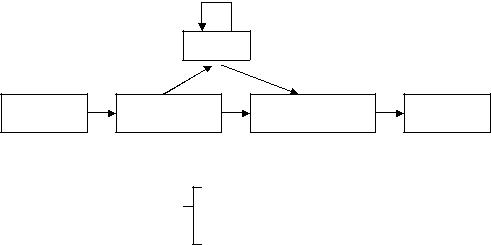
26
SEQUENTIAL ORGANIZATION (F. ORGANISATION SÉQUENTIELLE)
The SEQUENTIAL ORGANIZATION is an ELEMENTARY ORGANIZATION FORM, which aims at defining and delimitating in a text various prototypical sequences, i.e. NARRATIVE, DESCRIPTIVE and DELIBERATIVE SEQUENCES, by COUPLING HIERARCHICAL and REFERENTIAL information.
A NARRATIVE SEQUENCE is defined by the COUPLING of the PRAXEOLOGICAL STRUCTURE of a STORY, which corresponds to the superstructure described by Adam (1992), and can be represented by the means of the following graph :
REACTION
|
INITIAL STATE |
COMPLICATION |
RESOLUTION |
FINAL STATE |
|
|
STORY
with the HIERARCHICAL macro-structure of a MOVE:
sM
M
mM
As far as the PRAXEOLOGICAL REPRESENTATION of STORY is concerned, let us specify that:
1)STORY may appear in any position, in order to warrant the recursivity of the system : a STORY may be used as the INITIAL STATE or as the COMPLICATION of another STORY ;
2)the position of the REACTION allows it to be optional or recurrent, depending on the complexity of the STORY ;
3)INITIAL and FINAL STATES may be implicit.
A NARRATIVE SEQUENCE can thus be defined by the COUPLING the HIERARCHICAL STRUCTURE of a MOVE with the PRAXEOLOGICAL REPRESENTATION of a STORY.
A DESCRIPTIVE SEQUENCE is defined by the COUPLING of the CONCEPTUAL REPRESENTATION which corresponds to the superstructure of the DESCRIPTIVE SEQUENCE proposed by Adam (1992) and characterizes the object of a description by recursively analyzing its parts, properties, and proximity or analogy with other objects, with the HIERARCHICAL STRUCTURE of a MOVE.
A DELIBERATIVE SEQUENCE is negatively defined as the COUPLING of the HIERARCHICAL STRUCTURE of a MOVE with a REFERENTIAL REPRESENTATIONT which has neither the PRAXEOLOGICAL REPRESENTATION of a STORY nor the CONCEPTUAL REPRESENTATION of the description of an object. (Roulet, Filliettaz & Grobet 2001: chap. 11 gives a good example of an analysis of the sequences constituting a fable by La Fontaine).
SITUATIONAL COMPONENT (F. COMPOSANTE SITUATIONNELLE)
The Geneva Model takes the complex nature of discourse realities as the starting point of its methodological proposals, and seeks to elaborate systematic and empirically validated solutions to the crucial question of complexity. More specifically, the MODULAR approach aims at capturing this complexity by combining information referring to three distinct levels of analysis : the SITUATIONAL level, the TEXTUAL level and the LINGUISTIC level. From a
27
MODULAR perspective, discourse realities are best described as organized semiotic forms related to both linguistic conventions and situated actions.
SPECIFIC TEXT RELATION (F. RELATION TEXTUELLE SPÉCIFIQUE)
SUCCESSION RELATION (F. RELATION DE SUCCESSION)
STAGE RELATION (F. RELATION D'ETAPE)
see PRAXEOLOGICAL (UNITS AND RELATIONS)
STRATEGIC ORGANIZATION (F. ORGANISATION STRATÉGIQUE)
The study of the STRATEGIC ORGANIZATION, a COMPLEX ORGANIZATION FORM which may take into consideration all MODULES and ORGANIZATION FORMS, aims at describing the way the interactants manage in their discourse FACE and PLACE relations between them. Following Goffman (1972) and Brown & Levinson (1987), we distinguish the POSITIVE FACE, i.e. the image that a speaker/writer gives of him/herself, and the NEGATIVE FACE, i.e. his/her private territory. We admit that, depending on the praxeological stakes of the interaction, as well as on his/her personality and culture, each interactant may be more or less sensitive to the saving of such and such FACE and, consequently, that each MOVE may create a threat for the POSITIVE and NEGATIVE FACES of the interactants. In order to neutralize this potential threat, interactants have developed FACE WORK processes, which are manifested in LINGUISTIC, HIERARCHICAL, RELATIONAL, TOPICAL and POLYPHONIC structures. It is thus possible to analyze in the development and the construction of a discourse the strategies used by the interactants to save their FACES in order to reach their objectives. In our model of discourse analysis, the notion of FACE pertains to the REFERENTIAL MODULE, more precisely to the ACTIONAL FRAME.
As far as the notion of PLACE (Flahault 1978) or position (Goffman 1988) is concerned, it has been defined by Kerbrat-Orecchioni (1992: 71-140) as a vertical relation, a domination relation between the interactants. By contrast with the STATUS, which is stable, it is a product of the development of the interaction. A speaker may occupy a lower PLACE in relation to the addressee at the beginning of an interaction and progressively take a higher PLACE.
The analysis of the STRATEGIC ORGANIZATION of a discourse is mainly based on the COUPLINGS of LINGUISTIC, HIERARCHICAL, RELATIONAL, TOPICAL and POLYPHONIC information. (See Roulet, Filliettaz & Grobet 2001: chap. 12 for a detailed analysis of three examples).
SUBORDINATE CONSTITUENT (F. CONSTITUANT SUBORDONNÉ)
SYNTACTIC MODULE (F. MODULE SYNTAXIQUE)
This MODULE, which has not been specifically treated in the MODULAR approach to discourse analysis, includes the rules determining the categories and structures of the CLAUSES used in a language or a language variety. It also indicates the pragmatic instructions given by morphemes such as anaphors or verbal tenses, or by syntactic structures, such as left dislocations, which contribute to discourse interpretation.
28
TEXT (F. TEXTE)
By TEXT we mean the highest autonomous constituent of the HIERARCHICAL STRUCTURE of a spoken or written discourse, i.e. a MOVE if the discourse is MONOLOGIC (for instance a leading article) or an EXCHANGE if the discourse is DIALOGIC (for instance a phone call).
TEXT ACT (F. ACTE TEXTUEL)
The TEXT ACT is the minimal constituent of the HIERARCHICAL STRUCTURE of a TEXT.
“The minimal textual constituent, which we call text act, is not defined in linguistic but in cognitive and interactionist terms as the smallest unit of a negotiation process; as such, it is characterized by two features, which have been described independently but which are manifestly linked:
a)the information given by a text act must be conceptually independent (as shown by Schilperoord & Verhagen 1998); for example, a main clause that is followed by a restrictive relative or a complement clause is not conceptually independent and is not a distinct text unit, whereas a main clause followed by an adverbial clause is a distinct text unit; thus, the following sequence, which consists of three clauses:
Bien que ma voisine soit déjà riche, elle espère toujours qu'elle va gagner le gros lot [Although my neighbour is quite rich, she always hopes that she will win the jackpot]
is analyzed in two text acts.
b)a text act may be registered in discourse memory, which is attested by the possibility to replace by a definite expression in the following clause an anaphoric pronoun that refers to an element in the first clause (as shown by Berrendonner 1990). Thus, in our example, one can replace elle in the second clause by la brave femme, which confirms that the first clause is a text act; it is impossible for elle in the third clause:
Bien que ma voisine soit déjà riche, elle (la brave femme) espère toujours qu'elle (*la brave femme) va gagner le gros lot
In order to explain the use of la brave femme, we must hypothesize that the information given by the first clause has been stored in discourse memory before the uttering of the second.
If it is possible to substitute the first anaphoric pronoun by a definite expression without loosing co-reference, it is not the case for the second anaphoric pronoun. This confirms that this sequence consists of two text acts and that the border between them is before the first anaphoric pronoun.
As the same test applies to left dislocated noun phrases such as
Ma voisine, je ne veux plus entendre parler d'elle (de cette brave femme) [my neighbour, I don't want to hear any longer about her (this brave lady)]
that are not complement of the verb, they must be considered as distinct text acts, as shown by Auchlin (1993).
It means that a text act should not be confused with the traditional speech act, as it does not necessarily have an illocutionary function and need not coincide with a clause: a subordinate act expressing a counter-argument can be expressed by a prepositional phrase (malgré la pluie [in spite of the rain]), which has no illocutionary function, as well as by a clause (bien qu'il pleuve or il a beau pleuvoir [although it is raining]) (see Rubattel 1987)” (Roulet 2005. For a more detailed presentation and illustration of our methodology for text segmentation, including other criteria, see Roulet 2002, Simon 2004 and Roulet, Filliettaz & Grobet 2001: chap. 3).
TEXT RELATION MARKER (F. MARQUEUR DE RELATION TEXTUELLE)
29
TOP-DOWN METHODOLOGY (F. MÉTHODOLOGIE DESCENDANTE)
The MODULAR approach to discourse analysis, following Pike and Bakhtine, applies a TOP DOWN METHODOLOGY, from interactions to text and linguistic constituents, which contrasts with the BOTTOM-UP METHODOLOGY, from phonemes to morphemes and clauses which is traditionally applied in linguistics.
“Aligning ourselves with Bakhtine's (1972) proposals, we call for a top-down methodology consisting in describing discourse in reference to a) the real situations in which it is used, b) the textual configurations it gives rise to, and c) the conventional resources it conveys and draws from. In various ways, such a top-down methodology contrasts with other paradigms – like radical pragmatics for instance […] – that tend to privilege a reductionist approach focused exclusively on propositions conceived as the elementary building blocks of communicative processes. In our perspective, the complexity of discourse organization does not come down to the mere combination of a plurality of statements. Nor can it be described comprehensively in terms of processing information and carrying out inferences. Rather, it results both from the constructed character of speech productions and from the variety of interrelated levels of information that are combined in such semiotic realities.” (Filliettaz & Roulet 2002: 374. See Roulet, Filliettaz & Grobet 2001: chap. 1 and 2 for a presentation of the historical background and of the methodology of the MODULAR approach to discourse analysis respectively).
TOPIC (F. TOPIQUE)
see INFORMATIONAL ORGANIZATION
TOPICAL ORGANIZATION (F. ORGANIZATION TOPICALE)
The TOPICAL ORGANIZATION is a COMPLEX ORGANIZATION FORM based on the COUPLING of INFORMATIONAL, HIERARCHICAL and REFERENTIAL information. It mainly aims at describing the hierarchy of the DISCOURSE OBJECTS analyzed in the informational organization and the derivation relations holding between such objects.
In order to describe the hierarchy of the DISCOURSE OBJECTS in a text, one just has to COUPLE the HIERARCHICAL STRUCTURE with the INFORMATIONAL ORGANIZATION: the main or subordinated status of a DISCOURSE OBJECT in relation to another one is determined by the position in the HIERARCHICAL STRUCTURE of the ACTS which activate these DISCOURSE OBJECTS.
In order to describe the PRIMARY or DERIVED status of a DISCOURSE OBJECT in relation to another, one just has to COUPLE the CONCEPTUAL STRUCTURE with the INFORMATIONAL ORGANIZATION: a DISCOURSE OBJECT which dominates another DISCOURSE OBJECT in the CONCEPTUAL STRUCTURE is PRIMARY and the dominated DISCOURSE OBJECT is DERIVED from the PRIMARY one (see Roulet, Filliettaz & Grobet 2001: chap. 9 and Grobet 2002 for a more thorough presentation and examples).
TRANSACTION (F. TRANSACTION)
see PRAXEOLOGICAL (UNITS AND RELATIONS)
TURN (F. TOUR DE PAROLE)
Goodwin (1981: 2) gives the following definition: "The talk of one party bounded by the talk of others constitutes a turn". In the Geneva model of discourse analysis, the TURN, a material unit pertaining to the INTERACTIONAL MODULE, should not be confused with the MOVE, a constituent of the HIERARCHICAL STRUCTURE. TURNS often

30
do not coincide with constituents of the conversation hierarchy, as one may detect a TURN corresponding to two MOVES, as well as three TURNS corresponding to one ACT or MOVE, as in the case of CO-ENUNCIATION.
“In fact, a turn is a unity which pertains to the surface structure of conversation, since it is uniquely marked by a change of speaker and does not necessarily coincide with the speech activities (like questions, answers, requests, etc) of the speakers. Thus, a speaker may well, in the same turn, utter a first move (for instance an evaluation), which closes the preceding exchange, and a second move (a question), which opens the next exchange. Even if those two moves belong to the same turn, there is no direct functional relation between them: each move is related to the other moves of the exchange to which it belongs. On the other hand, a request move may extend on many turns if […] it is followed by subordinate exchanges aiming at completing the initial request” (Roulet 1992: 92-93; see also Roulet 1999c).
UTTERED DISCOURSE (F. DISCOURS PRODUIT)
BIBLIOGRAPHICAL REFERENCES
ADAM J.-M. (1992), Les textes: types et prototypes, Paris, Nathan.
AUCHLIN A. (1993), Faire, montrer, dire. Pragmatique comparée de l’énonciation en français et en chinois, Berne, Lang.
-(1998), "Les dimensions de l'analyse pragmatique du discours dans une approche expérientielle et systémique de la compétence discursive", in J. Verschueren (ed.): Pragmatics in 1998: Selected papers from the 6th International Pragmatics Conference, vol. 2, Anvers, International Pragmatics association.
-(2003), "Compétence discursive et co-occurrence d’affects: “ blends expérientiels ” ou (con)fusion d’émotions?", in COLLETTA, J.-M. & A. TCHERKASSOF (ed.), Les émotions. Cognition, langage et développement, Hayen,
Mardaga, 137-152.
BAKHTINE M. (under the name of V.N. VOLOSINOV) (1973), Marxism and the philosophy of language, New York, Seminar Press.
-(1981), “Discourse in the novel”, in The dialogic imagination. Four essays, Austin, University of Texas Press. BERRENDONNER A. (1983), "Connecteurs pragmatiques et anaphores", Cahiers de linguistique française 5, 215-
246.
-(1990), "Pour une macro-syntaxe", Travaux de linguistique 21, 25-36.
-(1993), " Périodes ", in H. PARRET (ed.) Temps et discours, Louvain, Presses universitaires de Louvain, 47- 61.
BRONCKART J.-P. (1997), Activité langagière, textes et discours, Lausanne, Delachaux & Niestlé.
CARON J. (1997), "Psychologie cognitive et interactions conversationnelles", in BERNICOT J., J. CARON-PARGUE & A. TROGNON (eds), Conversation, interaction et fonctionnement cognitif, Nancy, Presses Universitaires de Nancy, 221-237.
CHAFE W.L. (1994), Discourse, Consciousness and Time, Chicago, Chicago University Press. CHARAUDEAU P. (1995), "Une analyse sémiolinguistique du discours", Langage 117, 96-111. VAN DIJK T. (1997) (ed), Discourse as Social Interaction. London, Sage.

31
DRESCHER M. & T. KOTSCHI (1988), “Das Genfer Modell?, Diskussion eines Ansatzes zur Diskursanalyse am Beispiel der Analyse eines Beratungsgesprächs“, Sprache und Pragmatik 8, 1-42.
EGNER I. (1988) , Analyse conversationnelle de l’échange réparateur en wobé, Berne, Lang.
ESPUNY J. (1997), Etude de la diaphonie dans des dialogues en face à face, Barcelone, Publicaciòn Universitat de Barcelona.
FAIRCLOUGH N. (1988), " Discourse representation in media discourse ", Sociolinguistics 17, 125-139.
FERRARI A. & A. AUCHLIN (1995), "Le point: un signe de ponctualisation", Cahiers de linguistique française 17, 35-56. FILLIETTAZ L. (2002), La parole en action, Québec, Nota Bene.
-(2003), “Action, cognition and interaction. The expression of motives in bookshop encounters”, in INCHAURRALDE C. & C. FLOREN (eds). Interaction and cognition in linguistics, Berne, Lang, 51-62.
-(2004), “The multi-modal organization of service encounters”, in LEVINE P. & R. SCOLLON (eds): Discourse &
technology. Multimodal discourse analysis, Washington, Georgetown University Press,
FILLIETTAZ L. & E. ROULET (2002), “The Geneva Model of discourse analysis : an interactionist and modular approach to discourse organization ", Discourse Studies 4, 369-393.
FLAHAULT F. (1978), La parole intermédiaire, Paris, Seuil.
FODOR J.A. (1983), The Modularity of Mind, Cambridge, MIT Press.
GOFFMAN E. (1972), Interaction ritual: essays on face-to-face behaviour, Harmondworth, Penguin Books. - (1988), "L’ordre de l’interaction", in Les moments et leurs hommes, Paris, Seuil, 186-230.
GOODWIN C. (1981), Conversational organization. Interaction between speakers and hearers, New York, Academic Press.
GROBET A. (1997), "La ponctuation prosodique dans les dimensions périodique et informationnelle du discours", Cahiers de linguistique française 19, 83-123.
-(2002), L’identification des topiques dans les dialogues, Bruxelles, Duculot.
JAKOBSON R. (1960), " Closing statements : Linguistics and poetics ", in SEBEOK, T. (ed.), Style in language, New York, 1960.
JEANNERET T. (1999), La coénonciation en français: approches discursive, conversationnelle et syntaxique, Berne, Lang.
KASHER A. (1991), "On the pragmatics modules: A lecture", Journal of pragmatics 16, 381-397. KERBRAT-ORECCHIONI C. (1992), Les interactions verbales, vol. 2, Paris, Colin.
KUYUMCUYAN A. (2002), Diction et mention, Berne, Lang.
LABOV W. & D. FANSHEL (1977), Therapeutic Discourse, New York, Academic Press. LAKOFF G. & M. JOHNSON (1980), Metaphors we live by, Chicago, University Press.
MELL J. (1992), Etude des communications verbales entre pilote et contrôleur en situation standard et non standard, Toulouse, ENAC.
MICHE E. (1998), Secuencias discursivas del desacuerdo, Santiago de Compostella, Verba.
MOTSCH W. (1989), "Dialog-Texte als modular organisierte Strukturen", Sprache und Pragmatik 11, 37-66.
-(1991), "Anforderungen an eine modulare Textanalyse", Sprache und Pragmatik 24, 47-61. NØLKE H. (1994), Linguistique modulaire: de la forme au sens, Louvain, Peeters.
-(1999), “Linguistique modulaire; principes méthodologiques et applications”, IN NØLKE H. & J.M. ADAM (éds),
17-73,
NØLKE H. & J.M. ADAM (eds) (1999), Approches modulaires: de la langue au discours, Neuchâtel, Delachaux &
32
Niestlé.
PIRES S. (1997), Estratégias discursivas na adolescência, Sao Paulo, Editora Arte & Ciencia.
ROULET E. (1981), "Echanges, interventions et actes de langage dans la structure de la conversation", Etudes de linguistique appliquée 44, 7-39.
-(1984). “Speech acts, discourse structure, and pragmatic connectives”, Journal of Pragmatics 8, 31-47.
-(1987), "L’intégration des mouvements discursifs et le rôle des connecteurs interactifs dans une approche dynamique de la construction du discours monologique", Modèles linguistiques 9, 19-31.
-(1990), " Et si, après tout, ce connecteur n'était pas un marqueur d'argument ou de prémisse impliquée?", Cahiers de linguistique française 11, 1990, 329-343.
-(1992), "On the Structure of Conversation as Negociation", in SEARLE J.R. et al, 91-99.
-(1995) “Geneva School”, in VERSCHUEREN, J., J.-A. ÖSTMAN & J. BLOMMAERT (eds): Handbook of pragmatics, Manual, Amsterdam, John Benjamins, 319-323.
-(1997), "A Modular Approach to Discourse Structures", Pragmatics 7, 125-146.
-(1998), "Polyphony", in VERSCHUEREN J., J.-O. ÖSTMAN & J. BLOMMAERT (eds), Handbook of Pragmatics, Amsterdam, John Benjamins.
-(1999a), " Une approche modulaire de la complexité de l’organisation du discours ", in NØLKE H. & J.M. ADAM (eds), 187-257.
-(1999b), La description de l’organisation du discours, Paris, Didier.
-(1999c), " Co-enunciation and the definition of dialogue units ", Verbum XXI, 233-242.
|
- |
(2002), " Le problème de la définition des unités à la frontière entre le syntaxique et le textuel ", Verbum 24, |
|
|
161-168. |
-(2005), “The description of text relation markers in the Geneva model of discourse organization”, in FISCHER K.
(ed.): Approaches to discourse particles, Elsevier
ROULET E. & al. (1985), L’articulation du discours en français contemporain, Berne, Lang, 3rd ed. 1991.
ROULET E. L. FILLIETTAZ & A. GROBET (2001), Un modèle et un instrument d’analyse de l’organisation du discours, Berne, Lang.
RUBATTEL C. (1987), "Actes de langage, semi-actes et typologie des connecteurs pragmatiques", Linguisticae investigationes XI, 379-404.
–(1990), "Polyphonie et modularité", Cahiers de linguistique française 11, 297-310.
SABAH G. (1989), L’intelligence artificielle et le langage, vol. 2, Processus de compréhension, Paris, Hermès. SACKS H. (1992), Lectures on Conversation, Oxford, Blackwell.
SCHILPEROORD J. & A. VERHAGEN (1998), "Conceptual dependency and the clausal structure of discourse", in KOENIG, J.P. (ed.), Discourse and Cognition. Bridging the Gap, Stanford, CSLI Publications, 141-163.
SEARLE J.R. et al. (1992), (On) Searle on Conversation, Amsterdam, J. Benjamins
SIMON H.A. (1962), "The architecture of complexity", Proceedings of the American Philosophical society 106, 467-482. SIMON A.-C. (2004), La structuration prosodique du discours en français, Berne, Lang.
TORCK D. (1994), "Diaphonie et interaction en face à face dans le débat politique", Littérature 93, 15-30.
VARELA F.J & al. (1991), The embodied mind : cognitive science and human experience, Cambridge, MIT Press.
French-English Glossary of linguistic terms
English definitions of key terms in the Geneva modular approach to discourse analysis
Author :
Eddy Roulet; Professeur à l'Université de Genève
English translation :
Catherine Walther Green, Maître-Assistante à l'Université de Genève
ACT (F. ACTE)
see TEXT ACT
ACTIONAL FRAME (F. CADRE ACTIONNEL)
ACTUAL REPRESENTED DISCOURSE (F. DISCOURS REPRÉSENTÉ EFFECTIF)
ARGUMENT RELATION (F. RELATION D’ARGUMENT)
AUTHENTIC DISCOURSE (F. DISCOURS AUTHENTIQUE)
By AUTHENTIC, we mean pieces of discourses which have not been fabricated, or domesticated (to use Schegloff's terminology), to answer the analyst's needs. (See Roulet 1999a, Roulet 1999b, Roulet, Filliettaz & Grobet 2001, Kuyumcuyan 2002, Filliettaz 2002, Grobet 2002 and Simon 2004 for comprehensive and detailed analyses of phone calls, service encounters, interviews, debates, film and theater dialogues, narratives, letters, etc. in French. Similar works was performed on Chinese (Auchlin 1993), Wobe (Egner 1988), Portuguese (Pires 1997), German (Drescher & Kotschi 1988), Spanish (Miche 1998), Catalan (Espuny 1997) and English (Mell 1992)).
AXIOLOGICAL LEXICON (F. LEXIQUE AXIOLOGIQUE)
The AXIOLOGICAL LEXICON is made of all the lexemes which express a positive (for instance, wonderful, excellent) or negative (awful, ugly) point of view of the speaker/writer.
BOTTOM-UP METHODOLOGY (F. MÉTHODOLOGIE ASCENDANTE)
see TOP-DOWN METHODOLOGY
CLARIFICATION RELATION (F. RELATION DE CLARIFICATION)
CLAUSE (F. CLAUSE)
The CLAUSE is the highest constituent of the SYNTACTIC MODULE, i.e. the maximal independent proposition whose constituents are linked by either government, or marked coordination or subordination relations.
2
Thus, each of the following examples is a clause:
(1)Of such a mess, I have never heard
(2)I did not go out, because I was tired whereas the next examples are made up of two clauses:
(3)Such a mess, I have never heard of it
(4)I did not go out, in fact I was tired
(5)I did not go out, I was tired
It is important to note that the CLAUSE, the highest constituent of the SYNTACTIC HIERARCHY, does not necessarily coincide with the TEXT ACT, the minimal constituent of the TEXT HIERARCHY. In the examples above,
(1)is made up of one clause corresponding to one text act; (2) and (3) are made up of one clause corresponding to two text acts, (4) and (5) are made up of two clauses corresponding to two text acts (see Roulet 2002).
CO-CONSTRUCTION (F. CO-CONSTRUCTION)
The expression “CO-CONSTRUCTION OF A MOVE” is used when the interlocutor contributes to the construction of the speaker’s MOVE in a SUBORDINATE EXCHANGE, for instance a PRE or a CLARIFICATION ; see the following example where a bookseller contributes to the construction of the customer’s request, by opening a subordinate exchange in order to clarify this request:
1 C. Est-ce que vous avez Contes et nouvelles d'Oscar Wilde? 'Would you have...?'
2 B. Oscar Wilde ...
3En français? 'In French?
4C. Euh ... oui. 'Yes'
CO-ENUNCIATION (F. COÉNONCIATION)
Jeanneret (1999) uses the term CO-ENUNCIATION, corresponding to Sack (1992)’s COLLABORATIVE COMPLETION, to describe the case where the interlocutor completes a speaker’s incomplete MOVE, as in the
|
following examples : |
|
|
|
1A |
donc je sais à peu près comment il faut être vis à vis de telle ou telle personne donc euh je |
|
|
|
comprends |
|
|
2B |
la méthode |
(see Jeanneret 1999 : 122) |
1C est-ce que vous vendez des petits rasoirs euh
2V qui se jettent/ (see Jeanneret 1999 : 176) (See also Roulet 1999c).
COLLABORATIVE COMPLETION (F. COÉNONCIATION)
see CO-ENUNCIATION
COMMENT RELATION (F. RELATION DE COMMENTAIRE)
COMPLEX ORGANIZATION FORM (F. FORME D’ORGANISATION COMPLEXE)
see MODULAR DEVICE
3
COMPOSITIONAL ORGANIZATION (F. ORGANISATION COMPOSITIONNELLE]
Most texts are sequentially heterogeneous, i.e. are made of different sequences, and it is very important to analyze the place and function of such sequences in the global organization of the text. The study of COMPOSITIONAL ORGANIZATION aims precisely at describing the place and the function in the text of the NARRATIVE, DESCRIPTIVE and DELIBERATIVE SEQUENCES delimitated in the study of the SEQUENTIAL ORGANIZATION, as well as so-called COMPOSITIONAL EFFECTS (argumentative, autotelic, etc). It is based on the COUPLING of SEQUENTIAL, LINGUISTIC, HIERARCHICAL and RELATIONAL information.
Thus, a NARRATIVE SEQUENCE may have two different positions and functions in the organization of an EXCHANGE. It may occupy the position of a REACTIVE MOVE, as a full answer to a question, or the position of an ARGUMENT MOVE subordinated to the MAIN TEXT ACT or MOVE of a REACTIVE MOVE, as shown in the following graphs (M = move, E = exchange, m = main, s = subordinate, arg = argument relation):
|
|
|
|
|
|
|
|
|
|
M |
|
|
|
E |
|
|
M |
|
|
|
|
|
|
mM |
|
|
|
|
|
|
|
|
|
|
||||
|
|
|
|
E |
|
|
|
M |
|
|||
|
|
|
|
|
|
|
|
|
||||
|
|
|
|
|
|
|
|
|
||||
|
|
|
|
|
|
|
|
|
||||
|
|
|
M independent narrative |
|
|
|
|
sM exemplary narrative |
||||
|
|
|
|
|
|
|
|
|
|
|||
|
|
|
|
|
|
|
|
|
|
|
|
|
|
|
|
|
|
|
|
|
|
|
M |
|
arg |
|
|
|
|
M |
|
|
|
|
|
|
|
|
|
|
|
|
|
|
|
|
|
|
|
|
|
|
|
|
|
|
|
|
|
|
|
|
|
|
The first illustrated position corresponds to an independent narrative, the second one to what is frequently called an exemplary narrative (F. récit exemplaire).
Besides, a NARRATIVE, DESCRIPTIVE or DELIBERATIVE SEQUENCE may be more or less marked as far as ARGUMENTATIVE and AUTOTELIC (or POETIC) EFFECTS are concerned. The description of such COMPOSITIONAL EFFECTS is based on the COUPLING of SEQUENTIAL and LINGUISTIC information: an ARGUMENTATIVE EFFECT is marked to various degrees by the presence in the text of argumentative CONNECTIVES and items drawn from the AXIOLOGICAL LEXICON; an AUTOTELIC (or POETIC) EFFECT, as shown by Jakobson (1960) by the recurrence of phono-graphic, syntactic, semantic and textual parallelisms.
(For a detailed example of the analysis of the COMPOSITIONAL ORGANIZATION of a text, see Roulet, Filliettaz & Grobet 2001: chap. 11).
COMPOSITIONAL EFFECT (F. EFFET COMPOSITIONNEL)
see COMPOSITIONAL ORGANIZATION
COMPREHENSIVE ANALYSIS (F. ANALYSE COMPRÉHENSIVE)
Labov & Fanshel (1977: 354) give the following definition: "By comprehensive, we mean that we have made ourselves accountable to an entire body of conversation, attempting to account for the interpretations of all utterances and the coherent sequencing between them”. The MODULAR approach to discourse analysis focuses on the COMPREHENSIVE ANALYSIS of naturally occurring talks or texts.
CONCEPTUAL MEANING (F. SENS CONCEPTUEL)
see LEXICAL MODULE
4
CONCEPTUAL STRUCTURE (F. STRUCTURE CONCEPTUELLE)
CONNECTIVE (F. CONNECTEUR)
CONSTANT TOPIC PROGRESSION (F. PROGRESSION À TOPIQUE CONSTANT)
see INFORMATIONAL ORGANIZATION
COUNTER-ARGUMENT RELATION (F. RELATION DE CONTRE-ARGUMENT)
COUPLING (F. COUPLAGE)
The notion of COUPLING is central to the modularity hypothesis: it allows, through specific meta-rules, for the combination of types of information coming from different MODULES in order to account for various aspects of the complexity of the organization of discourse. For instance, the complex notion “NARRATIVE SEQUENCE” is defined as the result of the COUPLING of the HIERARCHICAL STRUCTURE of a MOVE with the PRAXEOLOGICAL STRUCTURE of a STORY. See SEQUENTIAL ORGANIZATION.
DELIBERATIVE SEQUENCE (F. SÉQUENCE DÉLIBÉRATIVE)
DENOMINATIVE MARKER (F. MARQUEUR DÉNOMINATIF)
A DENOMINATIVE MARKER is the explicit expression of an INTERACTIVE or ILLOCUTIONARY RELATION, i.e. a CONNECTIVE such as for example or a performative verb such as promiss (see Roulet 1981).
DEPENDENCY LINK (F. RAPPORT DE DÉPENDANCE)
The constituents of the HIERARCHICAL STRUCTURE of a text may be related by three kinds of hierarchical links : DEPENDENCY, INTERDEPENDENCY and INDEPENDENCY LINKS. There is a DEPENDENCY LINK when the presence of one constituent is necessarily linked to the presence of another constituent (but not conversely) : the dependent constituent, which may be eliminated without destructing the global structure, is SUBORDINATE, the other one is a MAIN constituent. An INTERDEPENDENCY LINK holds between constituents which are necessarily co- present, for instance between the MOVES constituting an EXCHANGE. There is an INDEPENDENCY LINK when the presence of any of two successive constituents is not linked to the presence of the other one, i.e. between coordinated constituents. DEPENDENCY, INTERDEPENDENCY and INDEPENDENCY LINKS connect TEXT constituents and should not be confused with ILLOCUTIONARY and INTERACTIVE RELATIONS which connect TEXT constituents and information stored in DISCOURSE MEMORY and pertain to the RELATIONAL ORGANIZATION of the TEXT.
DESCRIPTIVE SEQUENCE (F. SÉQUENCE DESCRIPTIVE)
5
DESIGNATED REPRESENTED DISCOURSE (F. DISCOURS REPRÉSENTÉ DÉSIGNÉ)
DIALOGIC (F. DIALOGIQUE) / dialogical (F: DIALOGAL)
Roulet (1984) introduced a useful distinction between two oppositions : on the one hand, the opposition between MONOLOGIC and DIALOGIC discourse, based on the distinction between MOVE and EXCHANGE structures, and, on the other hand, the opposition between MONOLOGICAL and DIALOGICAL discourse, based on the number of speakers/writers. Thus, a MOVE constructed by two interlocutors (see CO-CONSTRUCTION) is both MONOLOGIC and DIALOGICAL, whereas a leading article simulating an EXCHANGE is both MONOLOGICAL and DIALOGIC.
DIAPHONY (F. DIAPHONIE)
DIALOGIC COMPLETION (F. COMPLÉTUDE DIALOGIQUE)
DISCOURSE (F. DISCOURS)
The term “DISCOURSE” is used to designate any verbal interaction, spoken or written, monologic or dialogic, bearing in mind its LINGUISTIC, TEXTUAL and SITUATIONAL properties.
DISCOURSE MEMORY (F. MÉMOIRE DISCURSIVE)
Berrendonner (1983) introduced the notion of DISCOURSE MEMORY in order to account for the heterogeneity of the information referred to by a CONNECTIVE or an anaphor; information stored in DISCOURSE MEMORY may have its source in the encyclopedic knowledge of the interactants, in the co-text, in the immediate cognitive environment, or in inferences drawn on the basis of either one of these elements.
DISCOURSE OBJECT (F. PROPOS, OBJET DE DISCOURS)
see INFORMATIONAL ORGANIZATION
ELEMENTARY ORGANIZATION FORM (F.FORME D’ORGANISATION ÉLÉMENTAIRE)
see MODULAR DEVICE
ENCOUNTER (F. INCURSION)
see PRAXEOLOGICAL (UNITS AND RELATIONS)
ENUNCIATIVE ORGANIZATION (F. ORGANISATION ÉNONCIATIVE)
The ENUNCIATIVE ORGANIZATION describes the different discourses which are produced or represented in a text, and embedded at various interaction levels, as well as the voices which these discourses manifest. It is based on the COUPLING of LINGUISTIC, INTERACTIONAL and REFERENTIAL information.
It is generally possible to analyze a speaker’s discourse into segments corresponding to distinct verbally manifested voices at various levels of embedding; for instance, the following utterances can be analyzed this way
6
(each segment is delimited by square brackets and the voice is indicated in front of it in boldface types: S = speaker, A = addressee, P = Paul, M = Maria, etc.):
S[Paul has written to me that P[Maria had told him that M[she was ill]]]
S[You say that A[it is a bad paper], I think it is excellent]
Among the different discourses present in a text, one first has to distinguish between the one which is currently PRODUCED (the present voice of the speaker), and those which are only REPRESENTATIONS (to use Fairclough (1988)’s expression) of other discourses (including past discourses of the speaker). In the following dialogue:
-Let's go out for a walk. It is sunny.
-It is sunny, but very windy.
the answer can be analyzed as two segments bearing two voices: the first segment represents the addressee's
discourse, the second produces the actual discourse of the speaker: thus S[A[It is sunny], but very windy].
It is not enough to distinguish the speaker's actual discourse from REPRESENTED DISCOURSES. Bakhtine (1981) clearly showed that it is also important to make a distinction between the representation of the discourse of the present addressee and the representation of the discourses of others, as they do not play the same role in discourse. For the speaker, representing the discourse of his/her partner, who may then react to it, is a part of the actual interaction between them; it is not the case for the representation of the discourse of persons who do not participate in the interaction, which is just a reference object among others. That is the reason why Roulet et al. (1985) introduced a distinction, that has been widely used since, between DIAPHONY, which refers to the representation of the addressee’s discourse, and POLYPHONY (in a restricted sense), which refers to the representation of any other discourse. In the case of DIAPHONY, it is useful to make an additional distinction between IMMEDIATE and DELAYED representations of the addressee's discourse, which may have different functions (see Torck 1994 and Espuny 1997).
Furthermore, one has to make a distinction between the present discourse (S) and represented discourses of the speaker/writer (S'), which we call AUTOPHONIC:
S[I have told you yesterday that S'[I was ill]]
One also has to distinguish between three different ways of representing another discourse: the speaker/writer can point to it (we use the term DESIGNATED REPRESENTED DISCOURSE), reproduce or formulate it (FORMULATED REPRESENTED DISCOURSE), or refer implicitly to it by a CONNECTIVE at the head of a reply (IMPLICATED REPRESENTED DISCOURSE). See the following examples:
Your protest has been duly registered (where the other’s discourse is designated by a verb) It is sunny but very windy (where the other’s discourse is (re)formulated)
But it is very windy (in this answer the addressee’s discourse is implicitly referred to by the instructions given by the connective but).
The DESIGNATED REPRESENTED DISCOURSE is indicated by empty square brackets after the designating expression:
S[Your protest A[ ] has been duly registered]
The IMPLICATED REPRESENTED DISCOURSE is indicated by empty square brackets before the CONNECTIVE: S[ A[ ] But it is very windy]
One has to distinguish between ACTUAL and POTENTIAL REPRESENTED DISCOURSE, as illustrated in the following examples:
You said that I am negligent, but I can't accept this accusation
You might say that I am negligent, but I can’t accept this accusation.
7
Finally, let us examine the ENUNCIATIVE ORGANIZATION of the following translation of a fragment of a letter written by George Sand to her mother
It is foolishness, you say, my dear mother, to learn Latin. I don't know who may have told you that I undertook such a study. Anyway you have been misled, because I neither know nor learn Latin. But, even if I did learn Latin, I am extremely surprised that you, my mother, might find it bad that I would improve my instruction. (Correspondance de George Sand, Paris, Garnier, 1964, 74-81).
It can be described in the following way (with S = George Sand, M = mother, X =undefined voice):
S[you say, my dear mother M[it is foolishness to learn Latin]. I don't know who may have told you that X[I undertook such a study]. Anyway you have been misled, because I neither know nor learn Latin. But, even if M[I did learn latin], I am extremely surprised that you, my mother, might find M[it bad that I would improve my instruction]].
The ENUNCIATIVE ORGANIZATION presents little interest in itself, but it constitutes the basis for the study of the POLYPHONIC ORGANIZATION of the text. (See the descriptions of the ENUNCIATIVE ORGANIZATION of a letter and novel dialogue in Roulet 1999b: chap. 9 and 10, and of a sketch in Kuyumcuyan 2002).
EPISODE (F. EPISODE)
see PRAXEOLOGICAL (UNITS AND RELATIONS)
EXCHANGE (F. ÉCHANGE) :
EXPERIENTIAL APPROACH (F. APPROCHE EXPÉRIENTIELLE)
From his research on what he calls "conversational happiness" (Auchlin 1991), Auchlin introduced into MODULAR researches on discourse an experiential dimension. The EXPERIENTIAL APPROACH, which relies on work by Lakoff
&Johnson (1980) and Varela et al. (1991), aims at integrating into the study of discourse a qualitative dimension (ethos, blends) and a temporal dimension (rhythm, tempo, variations), which are the locus of interactional synchronization. It aims at describing “discursive competence”, defined as the ability to construct experience through discourse (see Auchlin 1998 and 2003; see also Simon 2004 for an experiential study of the role of prosody in discourse).
FACE WORK (F. FIGURATION)
FORMULATED REPRESENTED DISCOURSE (F. DISCOURS REPRÉSENTÉ FORMULÉ)
GENERIC RELATION (F. RELATION GÉNÉRIQUE)
8
HETERARCHICAL (ARCHITECTURE) (F. HÉTÉRARCHIQUE (ARCHITECTURE))
The architecture of the MODULAR system in the Geneva model of discourse analysis is not serial, as in Motsch (1989, 1991)'s proposal, but HETERARCHICAL (Sabah 1989, 49-50), which means that in principle it allows for COUPLINGS between the outputs of all MODULES and ELEMENTARY or COMPLEX ORGANIZATION FORMS.
HIERARCHICAL MODULE (F. MODULE HIÉRARCHIQUE)
The HIERARCHICAL MODULE is concerned with the recursive categories and rules accounting for the structure of both MONOLOGIC and DIALOGIC TEXTS. It defines text constituents: EXCHANGE, MOVE and TEXT ACT, as well as the DEPENDENCY, INTERDEPENDENCY and INDEPENDENCY LINKS between them.
“Our conception of text structure is based on the hypothesis that the construction of any verbal interaction or written text reflects a process of negotiation in which speakers/writers recursively initiate, react on, or ratify propositions by means of text constituents belonging to various hierarchical levels: exchanges, moves and acts. Thus, our model postulates a recursive hierarchical structure, which is governed by two distinct completion principles. The principle of dialogical completion states that an exchange comes to an end when both interactants agree about the closure of a negotiation process. As for the principle of monological completion, it states that each move constituting an exchange should provide sufficiently relevant information in order to function as an adequate contribution to a negotiation process. This explains why moves are frequently formulated by means of a complex sequence of acts, moves, and subordinate exchanges. The hierarchical structure is defined by rules which specify how an exchange can be analyzed into moves, and a move into a main act, possibly accompanied by exchanges, moves and acts which are subordinated to it” (Roulet 2005; see also Roulet, Filliettaz & Grobet 2001: chap. 3).
“The analysis of tape-recorded dialogs reveals the complex nature of discourse units, such as questions, requests and responses, which are generally considered illocutionary acts; this complexity makes it necessary to go beyond the local and linear study of sequential regularities in conversation (adjacent pairs, principles of turn taking) described by e.g. Sacks and Schegloff, and to postulate a hierarchical structure with at least three levels:
1.each dialog can be analyzed into one or more exchanges;
2.each exchange can be analyzed into moves, linked by the initiative and/or reactive illocutionary functions which are generally attributed to speech acts; thus, a question move may be followed by an information/response move, which may in turn be followed by an evaluation move; a move is a functional unit that should not be confused with the formal dialog unit called "turn" by ethnomethodologists: a turn may consist of the last move of a preceding exchange and of the first move of the next exchange;
3.each move can be analyzed into a main [text] act, possibly accompanied by exchanges, moves, or acts which are subordinated to it; those constituents are linked by so-called interactive relations ([preliminary, argument,] reformulation); a [text] act is not to be confused with the traditional speech act: it does not necessarily coincide with a syntactic sentence, as a prepositional or a noun phrase like in spite of the rain can be linked by an interactive relation to another [text] constituent. […].
To show the importance of the hierarchical and relational dimensions of dialog structures […], let us consider a brief exchange, which has been recorded in a Swiss bookshop, between a customer (C) and the bookseller (B):
1 C. Est-ce que vous avez Contes et nouvelles d'Oscar Wilde? 'Would you have...?' 2 B. Oscar Wilde ...
3 En français? 'In French?
4 C. Euh ... oui. 'Yes'
5 B. Bon. 'OK'
9
6 C. S'il vous plaît. 'Please'
7 B. Dans quelle collection? 'In which series?' 8 C. J'sais pas ... euh... 'I don't know'
9c'que vous avez. 'whichever you have'
10B. Bon. 'OK'
11Cher Monsieur, j'ai rien. 'Dear Sir, I don't have anything'
12C. Vous avez rien? 'Don't you?'
13B. Non j'ai rien. 'No'
Instead of a very simple and linear request exchange (Est-ce que vous avez...? Non j'ai rien. Tant pis 'Too bad'), we observe a complex hierarchical structure. Actually, the initial request made by the customer is not considered complete by the bookseller for at least two reasons: First, its illocutionary force is ambiguous (question or request), and the customer is forced to solve this ambiguity by adding s'il vous plaît 'please', which is a clear request marker; Second, it is not a complete request for a bookseller who knows that there are many editions of Oscar Wilde's short stories in different languages, which triggers two successive subordinate exchanges to get the missing information. At last, the negative answer given by the bookseller compels the customer to reformulate his request and thus extend the exchange. The following hierarchical structure clearly shows the complexity of this short exchange (E = exchange, M = move, A = text act, m = main, s = subordinate):
|
|
|
|
|
|
|
|
|
|
|
|
|
|
|
sM |
|
|
|
mA [1] |
|
M |
|
sA [2] |
|||
|
|
|
|
|
|
|
|
|
|
|
|
|
|
|
|
|
|
|
|
|
||||||
|
|
|
|
|
|
|
|
|
|
mM |
|
|
|
|
|
|
|
sE |
|
|
mA [3] |
|||||
|
|
|
|
|
|
|
|
|
|
|
|
|
|
|
|
|
|
|
|
|
|
|
||||
|
|
|
|
|
|
|
|
|
|
|
|
|
|
mA [6] |
|
|
|
|
M [4] |
|
||||||
|
|
|
|
|
|
|
|
|
|
|
|
|
|
|
|
|
|
|
|
|||||||
|
|
|
|
|
|
|
|
|
|
|
|
|
|
|
|
|
|
|
|
|||||||
|
|
|
|
|
|
|
|
|
|
|
|
|
|
|
|
|
|
|
|
|
||||||
|
|
|
|
|
|
|
|
|
|
|
|
|
|
|
|
|
|
|
|
|
|
|||||
|
|
|
|
|
M |
|
|
|
|
|
|
|
|
|
|
|
|
|
|
M [5] |
|
|
||||
|
|
|
|
|
|
|
|
|
|
|
|
|
|
|
|
|
|
|
||||||||
|
E |
|
|
|
|
|
|
|
|
|
|
|
|
M [7] |
sA [8] |
|
|
|
||||||||
|
|
|
|
|
|
|
|
|
|
|
|
|
|
|
|
|
||||||||||
|
|
|
|
|
|
|
|
|
|
|
|
|
|
|
|
|
|
|||||||||
|
|
|
|
|
|
|
|
|
|
|
|
|
|
|
|
|
|
|||||||||
|
|
|
|
|
|
|
|
|
E |
|
|
|
M |
|
|
|
|
|
|
|
||||||
|
|
|
|
|
|
|
|
|
|
|
|
|
|
mA [9] |
|
|
|
|
||||||||
|
|
|
|
|
|
|
|
|
|
|
|
|
|
|
|
|
|
|
|
|||||||
|
|
|
|
|
|
|
|
|
|
|
|
|
|
|
|
|
|
|
|
|
|
|
||||
|
|
|
|
|
M |
[11] |
|
|
|
|
|
|
M [10] |
|
|
|
|
|
|
|
|
|||||
|
|
|
|
|
|
|
|
|
|
|
|
|
|
|
|
|
|
|
|
|
|
|
||||
|
|
|
|
|
|
|
|
|
|
|
|
|
|
|
|
|
|
|
|
|||||||
M[12]
M [13]
10
It is worth noting that the customer's request is constructed, or more precisely co-constructed with the assistance of the bookseller, in four steps: An act with an ambiguous initiative illocutionary force, a first subordinate exchange, a non ambiguous reformulation of the first act, and a second subordinate exchange. It would not have been necessary if the customer had uttered at once an elaborate request such as: J'aimerais Contes et nouvelles d'Oscar Wilde dans la collection Folio 'I would like to have Contes et nouvelles by Oscar Wilde in the Folio series'.” (Roulet 1995: 321-322).
ILLOCUTIONARY RELATION (F. RELATION ILLOCUTOIRE)
IMPLICATED REPRESENTED DISCOURSE (F. DISCOURS REPRÉSENTÉ IMPLICITÉ)
INDEPENDENCY LINK (F. RAPPORT D’INDÉPENDANCE)
see DEPENDENCY LINK
INFERENTIAL COMPUTATION (F. CALCUL INFÉRENTIEL)
In order to compute the SPECIFIC INTERACTIVE or ILLOCUTIONARY RELATION linking a text constituent to information stored in DISCOURSE MEMORY, one has to use one of the following procedures, depending on the presence or absence of a TEXT RELATION MARKER.
If there is no TEXT RELATION MARKER between two text constituents, the SPECIFIC TEXT RELATION must be computed inferentially by combining the information given by both constituents on the basis of our world knowledge. For instance, we can hypothesize an ARGUMENT RELATION to hold between the two constituents of the following move: I will not go out, I have too much work, based on the REFERENTIAL (or contextual) knowledge that one does not go out when one has too much work. We can compute the relation by combining LINGUISTIC and REFERENTIAL information in the following way, using a simple model of inference that links premises to a conclusion:
|
premise 1 |
linguistic information |
S says to A that S will not go out |
|
|
(enriched logical form) |
|
|
premise 2 |
linguistic information |
S says to A that S has too much work |
|
|
(enriched logical form) |
|
|
premise 3 |
easiest accessible referential |
if one has too much work, one does not go out |
|
|
information |
|
|
conclusion |
interpretation |
S says to A that S will not go out because S has |
|
|
|
too much work (there is an argument relation between both |
acts).
If there is a TEXT RELATION MARKER, as in the following example:
I will not go out, after all I have too much work
one has to compute the SPECIFIC INTERACTIVE RELATION indicated by the CONNECTIVE in the following way:
|
premise 1 |
linguistic information |
S says to A that S has too much work |
|
|
(enriched logical form) |
|
|
premise 2 |
lexical information (instructions |
to say after all X is to present X as the result of a change of |
|
|
given by the connective after all) |
opinion |
|
|
|
11 |
|
premise 3 |
easiest accessible referential |
to say that one has too much work manifests a change of |
|
|
information |
opinion with regard to thinking that one has not so much |
|
|
|
work |
|
conclusion |
interpretation |
S presents the assertion that S has too much work |
|
|
|
as the result of a change of opinion (he first thought that he did |
|
|
|
not have so much work) (there is a reformulation relation, |
|
|
|
expressing a change of opinion, between the act and the |
|
|
|
information stored in discourse memory). |
If we add this computation to the preceding one, we get the following final interpretation: S says to A that he will not go out because he has too much work, and he presents this argument as the result of a change of opinion.
This presentation of the computation of SPECIFIC TEXT RELATIONS is informal. Our approach is heuristic; it should allow us to better understand the processes involved in the organization and interpretation of discourse. In the present state of our knowledge, we do not have all the instruments that would allow us to formally compute the interpretation of AUTHENTIC DISCOURSE segments, i.e. segments that have not been fabricated by the analyst.
INDICATIVE MARKER (F. MARQUEUR INDICATIF)
It is a marker which indicates an INTERACTIVE or ILLOCUTIONARY RELATION by referring to Grice’s generalized conversational implicature ; it indicates the relation in a non explicit, but non ambiguous way ; for example please is an INDICATIVE MARKER of the SPECIFIC ILLOCUTIONARY RELATION “request”, whereas after all is an INDICATIVE MARKER of THE SPECIFIC INTERACTIVE RELATION “reformulation due to a change of opinion” (see Roulet 1981).
INFORMATIONAL ORGANIZATION (F. ORGANISATION INFORMATIONNELLE)
The INFORMATIONAL ORGANIZATION describes the progression of the information flow in discourse.
“[…] I hypothesize that each act introduces or activates an idea (to use Chafe's terminology, see Chafe 1994), which may be complex, and that it does so in relation to some semi-active information, which is stored in discourse memory. This semi-active information may come from encyclopedic knowledge, from the preceding act, from the physical environment, or from inferences which are derived from those sources. The semi-active information which constitutes the anchoring point in discourse memory may be verbalized in the act which activates an information by a trace, such as a pronoun or a definite expression. If there is no linguistic trace of the anchoring point, one looks for the more accessible relevant information in discourse memory. I use the term topic for the semi-active information which is the anchoring point for some activated information, and I call the information which is newly activated in an act discourse object.” (Roulet 1997: 136).
The INFORMATIONAL ORGANIZATION also describes the type of progression: CONSTANT TOPIC PROGRESSION, if two successive acts have the same TOPIC, LINEAR PROGRESSION if an act takes as DISCOURSE OBJECT the TOPIC of the preceding act.
See the following analysis of the INFORMATIONAL STRUCTURE of a fragment of a letter by George Sand concerning her behavior. We use boldface types to mark a topical trace (i.e. the trace of an immediate anchoring point in DISCOURSE MEMORY). If there is no topical trace in the act, one has to look for the most relevant accessible information (which we have shown in parentheses); if there is an anaphoric trace, the anchoring point is indicated
|
between square brackets. |
|
|
(GEORGE’S BEHAVIOR) It is foolishness, |
|
|
(FOOLISHNESS) you say, my dear mother, |
linear progression |
|
|
12 |
|
(FOOLISHNESS) to learn Latin. |
constant topic progr. |
|
I don't know who may have told you that I undertook such a study.(TO LEARN LATIN) linear progression |
|
|
(WHO, SOMEBODY) Anyway you have been misled, |
linear progression |
|
because I neither know nor learn Latin. |
|
|
But, even if I did learn Latin, |
constant topic progr. |
(LEARN LATIN) I am extremely surprised that you, my mother, might find it bad that I would improve my instruction constant topic progr.
The INFORMATIONAL ORGANIZATION presents little interest in itself, but it constitutes the basis for the study of the TOPICAL ORGANIZATION of the TEXT. (See Grobet 2002 for a more thorough treatment of the INFORMATIONAL ORGANIZATION).
INITIATIVE ILLOCUTIONARY RELATION (F. RELATION ILLOCUTOIRE INITIATIVE)
INSTRUCTIONAL MEANING (F. SENS INSTRUCTIONNEL, PROCÉDURAL)
see LEXICAL MODULE
INTERACTIONAL FRAME (F. CADRE INTERACTIONNEL)
INTERACTIONAL MODULE (F. MODULE INTERACTIONNEL)
The INTERACTIONAL MODULE defines the material properties of an interaction, at various levels of embedding: on the one hand, the material occupation of the channel by the speakers/writers, i.e. the turn-taking processes ; on the other hand the INTERACTIONAL FRAME, i.e. the number and the material positions of the interactants: temporal and/or spatial co-presence or distance, written, oral and/or visual, reciprocal or not reciprocal relation. An INTERACTION POSITION defines the identity of each interactant by combining the values of the three last parameters we have mentioned.
The interactional frame of, for instance, a TV interview can be represented by the following scheme:
|
TV chain |
X |
Y |
public |
|
producer |
interviewer |
interviewee |
addressee |
oral
spatio-temporal co-presence reciprocity
<INTERVIEW>
oral and visual
temporal and spatial distance no reciprocity
BROADCAST>
13
INTERACTION POSITION (F. POSITION D’INTERACTION)
INTERACTIONISM (F. INTERACTIONNISME)
An INTERACTIONIST APPROACH, as defined by Bakhtine (1973), is centered on the analysis of discourse, be it dialogic or monologic, spoken or written, as interaction.
“By conceptualizing discourse as communicative action, the Geneva Model clearly subscribes to the epistemological assumptions shared by the interactionist tradition. As recently stated by Bronckart (1997), adopting the position of socio-discursive interactionism consists in describing semiotic forms as addressed and evaluated realities, over time sedimented in social actors' habitus. From this standpoint, analysing communicative actions means going beyond a clear-cut delimitation between cognitive and socio-constructionist approaches to context. Mediated by general cultural expectations (discursive genres, frames, practices etc.), but necessarily negotiated in specific situations, discourse realities do not come down to predetermined sets of scripted conducts. Nor can they be described satisfactorily as strictly emergent processes. Rather, they must be analyzed as a combination of both typified social knowledge and interpersonal negotiation. An interactionist position also assumes the complex nature of discourse realities and calls to take into account the plurality and variety of components mobilized in its description. Following Charaudeau (1995: 97), the model assumes that language use entails minimally a) a cognitive dimension, b) a social and psycho-social dimension, and c) a semiological dimension. Moreover, as mentioned by Bronckart (1997: 80), texts and talks depend on multiple and heterogeneous parameters ranging from situated actions and speech genres to discourse types, text structures and linguistic components. In sum, it appears that "discourse analysts tend to theoretically decompose discourse at various layers, dimensions or levels and at the same time to mutually relate such levels. These levels represent different types of phenomena involved in discourse, such as sounds, forms, meanings, or action" (van Dijk 1997a: 30). The Geneva Model takes the complex nature of discourse realities as the starting point of its methodological proposals, and seeks to elaborate systematic and empirically validated solutions to the crucial question of complexity.” (Filliettaz & Roulet 2003: 373-374).
INTERACTIVE RELATION (F. RELATION INTERACTIVE)
INTERDEPENDENCY LINK (F. RAPPORT D’INTERDÉPENDANCE)
see DEPENDENCY LINK
INTERRUPTION RELATION (F. RELATION D’INTERRUPTION)
see PRAXEOLOGICAL (UNITS AND RELATIONS)
INTONATION GROUP (F. GROUPE INTONATIF)
Simon (2004: 65) defines the INTONATION GROUP as the minimal prosodic unit. In French, it is a sequence of syllables with an accented syllable in final position, which may be preceded by one or more unaccented syllables. The successive INTONATION GROUPS which appear in a discourse are clustered in what we call PROSODIC MOVEMENTS.
14
LEXICAL MODULE (F. MODULE LEXICAL)
The LEXICAL MODULE consists of a dictionary which defines the pronunciation, orthography, syntactic and semantic features of the words of different language varieties. It does not only indicate the CONCEPTUAL MEANING of lexemes which have a referential meaning (table, eat, green, etc) but also the PROCEDURAL or INSTRUCTIONAL MEANING of forms such as deictics (I, here, yesterday) and CONNECTIVES (because, after all), which give instructions about how to find information stored in DISCOURSE MEMORY in order to interpret the present discourse.
LINEAR PROGRESSION (F. PROGRESSION LINÉAIRE)
see INFORMATIONAL ORGANIZATION
MAIN (ACT, MOVE) (F. PRINCIPAL (ACTE, INTERVENTION))
see DEPENDENCY LINK
MINIMAL ACTION (F. ACTION MINIMALE)
see PRAXEOLOGICAL (UNITS AND RELATIONS)
MODULAR DEVICE (F. MODULAIRE (DISPOSITIF))
Adopting a MODULAR DEVICE towards the description of discourse assumes that texts or talks may be analyzed in terms of distinct and interrelated phenomena of varying complexity. More specifically, such an approach aims at breaking down the different facets of discourse organization into their simplest primitive elements, and at describing the high complexity and diversity of the discourses we observe as the result of the progressive combination of such information pieces.
“The Geneva Model […] assumes that a modular approach constitutes an interesting and powerful methodology for describing the complexity of discourse organization. A strong and cognitive version of the modularity hypothesis has been formulated by Fodor (1983) and gave rise to interesting controversies (Caron 1997). It is therefore crucially important to specify that we adopt a distinct, strictly methodological, version of the modularity hypotheses, which profoundly differs from Fodor's proposals. Following Herbert Simon's work (Simon 1962), we take the position that any complex system of information may be broken down into a number of elementary sub-systems, whose combination consists in reconstructing problems of progressive complexity. Identifying and combining these elementary sub-systems enables to capture complex realities by means of accessible and accountable sub- problems.
In recent years, such a methodological conception of the modularity hypothesis has been developed into various domains of language sciences (Nølke and Adam 1999), and it gave rise to fruitful research devoted to the description of langue (Nølke 1994, 1999) or to that of various pragmatic units (Motsch 1991, Kasher 1991). Aligning ourselves with such perspectives, we take the position that a modular approach can be applied successfully to the description of discourse organization.
Adopting a modular methodology towards the description of discourse assumes that texts or talks may be analyzed in terms of different and interrelated phenomena of varying complexity. More specifically, such an approach aims at breaking down the different facets of discourse organization to their simplest primitive elements, and at describing the high complexity and diversity of the discourses we observe as the result of a progressive
15
combination between those pieces of information. Two main requirements are associated with a modular approach to discourse : first, to identify, delimit and define a restricted set of dimensions referring to elementary information ; and second, to describe precisely how these various elementary information may be combined in order to account for complex discourse processes. In order to satisfy those requirements, we consider two distinct theoretical categories, referring to two major steps in our analysis : (a) modules and (b) organization forms :
(a)Modules constitute the building blocks of a modular approach. They are the elements of the model dealing with the elementary dimensions of discourse organization. Following Nølke's (1994: 77) definition, they consist of coherent, maximally economical and notionally independent sub-systems of information. For instance, the hierarchical structure of a discourse segment can be characterized independently from its syntactic or lexical structures. Consequently, each module refers to a restricted set of elementary information and circumscribes a specific domain of discourse organization (the syntax, the lexicon, the textual hierarchy, the domain of reference, the interactional materiality).
(b)Organization forms are complex units of analysis. Contrary to modules, they do not consist of elementary systems of information, but result from what we call "couplings"i between such elementary sub-systems. For instance, it is by combining syntactic information with lexical one that one can account for the semantic organization of propositions. More specifically, we make a distinction between two types of organization forms : those resulting from a combination between elementary modules (elementary organization forms) ; and those combining elementary modules with other organization forms (complex organization forms). From our perspective, discourse phenomena such as topic organization […], polyphony […], story telling […], discourse strategies […], etc. are best described as complex organization forms : they do not come down to one homogeneous and delimited set of information, but result from a combination of a variety of linguistic, textual and situational components.
It is important to distinguish a modular from a multi-dimensional or multi-level approach. Adopting a multi- dimensional approach of discourse organization is to combine eclectically the results of studies on different dimensions of the organization of discourse in order to get a more complete picture of discourse organization. On the other hand, adopting a modular approach is to identify a restricted set of elementary components, and to account for complex discourse phenomena in terms of systematic combinations between those elementary elements.” (Filliettaz & Roulet 2003: 375-377; for a more developed treatment of the modularity hypothesis, see Nølke & Adam 1999).
The MODULAR DEVICE in the Geneva model of discourse analysis can be represented as follows:
MODULES
dimensions
L
Ilexical
N
G
U
Isyntactic
S
T.
T
E
X
T hierarchical
U
A
L
S
I
Treferential
U A T
Iinteractional
O N
16
ORGANIZATION FORMS
elementary complex
phono-prosodic or graphic
semantic
relationalperiodic
informationaltopical
enunciativepolyphonic
sequential compositional
strategic
operational
MODULE (F. MODULE) see MODULAR DEVICE
MONOLOGIC (F. MONOLOGIQUE) / MONOLOGICAL (F. MONOLOGAL) see DIALOGIC/DIALOGICAL
MONOLOGICAL COMPLETION (F. COMPLÉTUDE MONOLOGIQUE) see HIERARCHICAL MODULE
MOTIVATIONAL COMPLEX (F. COMPLEXE MOTIVATIONNEL) see REFERENTIAL MODULE
MOVE (F. INTERVENTION) see HIERARCHICAL MODULE
17
NARRATIVE SEQUENCE (F. SÉQUENCE NARRATIVE)
NEGATIVE FACE (F. FACE NÉGATIVE)
NEGOTIATION (F. NÉGOCIATION)
OPERATIONAL ORGANIZATION (F. ORGANISATION OPÉRATIONNELLE)
The OPERATIONAL ORGANIZATION is based on the COUPLING of HIERARCHICAL and PRAXEOLOGICAL structures.
If one wants to describe the organization of the following bookshop encounter (where C = customer and B = bookseller), which combines verbal and non verbal actions:
[C](a) (he enters), (b) Hello, (c) do you have Othello, (d) I need it for school
[B](e) (he looks on the shelves), (f) unfortunately not in my stock, (g) do you want me to order it
[C](h) yes please, (i) I’ll come again next week, (j) good bye, (k) (he goes out)
one has to describe its PRAXEOLOGICAL STRUCTURE and to combine it with the HIERARCHICAL STRUCTURE, in order to obtain the following OPERATIONAL STRUCTURE:
|
|
|
|
|
|
|
|
|
|
operational structure |
|
|
|
|
|
||||||||
|
|
|
|
|
praxeological structure |
|
|
|
|
textual structure |
|
||||||||||||
|
|
|
|
|
GOING IN (a) |
|
|
|
|
|
|
|
|
|
|
|
|
|
|
|
move |
|
|
|
|
|
|
|
|
|
|
|
|
|
|
|
|
|
|
|
|
|
|
|
|||
|
|
|
|
|
|
|
|
|
|
|
|
|
|
|
|
|
|
|
|
|
|
|
|
|
|
|
|
|
GREETING (b) |
|
|
|
|
|
|
|
|
|
|
|
|
|
|
|
|
||
|
|
|
|
|
stage |
|
|
|
|
|
|
|
|
|
|
|
|
|
|
|
initiative |
|
|
|
|
|
|
|
|
|
|
|
|
|
|
|
|
|
|
|
|
|
|
|
|
|
|
|
|
|
|
|
|
|
|
|
|
|
|
|
|
PHASE (c) |
|
main |
|
|
|
|
|
||
|
|
|
|
|
|
|
|
|
|
|
|
|
|
|
|
|
act |
|
|
|
|
move |
|
|
|
|
|
|
|
|
|
|
|
|
|
|
|
|
|
|
|
|
|
||||
|
|
|
|
|
|
|
|
|
|
|
|
|
|
|
|
|
|
|
|
|
|
initiative |
|
|
|
|
|
|
|
|
|
|
EPISODE |
|
|
|
|
|
|
sub. |
|
|
|||||
|
|
|
|
|
|
|
|
|
|
|
|
|
|
|
|
|
|
|
|||||
|
|
|
|
|
|
|
|
|
|
|
|
PHASE (d) |
|
act |
|
|
|
|
|
|
|||
|
|
|
|
|
|
|
|
|
|
|
|
|
|
|
|
|
|
|
|
|
|||
|
|
|
|
BUYING |
|
|
|
|
|
|
|
|
stage |
|
arg |
|
|
|
|
|
|||
|
|
|
|
|
|
|
|
|
|
|
|
|
|
|
|
|
|
||||||
|
|
|
|
|
|
|
|
|
|
|
|
|
|
|
|
|
|||||||
|
|
|
|
|
|
|
|
|
|
|
|
|
|
|
|
|
|||||||
|
|
|
|
|
|
|
|
|
|
|
|
|
|
|
|||||||||
|
|
|
|
TRANSACTION |
|
|
|
|
|
|
|
PHASE (e) |
|
|
|
|
|
|
|
|
|||
|
|
|
|
|
|
|
|
|
|
|
|
|
|
|
|
|
|
|
|||||
|
|
|
|
|
|
|
|
|
|
|
|
|
|
|
|
|
|
|
|||||
|
|
|
|
stage |
|
|
EPISODE |
|
|
|
|
|
|
|
|
|
|
||||||
|
|
|
|
|
|
|
|
|
|
|
|
|
|
|
|
|
|
||||||
|
ENCOUNTER |
|
|
|
|
|
|
stage |
|
|
|
PHASE (f) |
|
|
|
|
|
|
move |
|
|||
|
|
|
|
|
|
|
|
|
|
|
|
|
|
|
|
||||||||
|
|
|
|
|
|
|
|
|
|
|
|
|
|
|
|
|
|
|
|||||
|
|
|
|
|
|
|
|
|
stage |
|
|
|
|
|
|
reactive |
|
||||||
|
|
|
|
|
|
|
|
|
EPISODE (g) |
|
|
|
|
|
|
|
|
||||||
|
|
|
|
|
|
|
|
|
|
|
|
|
|
|
|
|
|
move |
|
||||
|
|
|
|
|
|
|
|
|
|
|
|
|
|
||||||||||
|
|
|
|
ORDERING |
|
|
|
|
|
|
|
|
PHASE (h) |
|
|
|
|
|
|
initiative |
|
||
|
|
|
|
|
|
|
|
|
|
|
|
|
main |
|
|
||||||||
|
|
|
|
|
|
|
|
|
|
|
|
|
|
|
|
|
|
||||||
|
|
|
|
TRANSACTION |
|
|
EPISODE |
|
|
|
|
act |
|
|
|
move |
|
||||||
|
|
|
|
reorientation |
|
|
|
|
|
|
|
|
|
|
|||||||||
|
|
|
|
|
|
stage |
|
|
|
PHASE (i) |
|
sub. |
|
|
|
reactive |
|
||||||
|
|
|
|
|
|
|
|
|
|
|
|
|
|
||||||||||
|
|
|
|
|
|
|
|
|
|
|
|
|
|
|
|
|
|||||||
|
|
|
|
|
|
|
|
|
|
|
|
|
|
|
stage |
|
act |
|
|
|
|
|
|
|
|
|
|
|
|
|
|
|
|
|
|
|
|
|
|
|
|
|
|
||||
|
|
|
|
GREETING (j) |
|
|
|
|
|
|
|
|
|
|
|
|
|
|
|||||
|
|
|
|
|
|
|
|
|
|
|
|
|
|
com. |
|
|
|
move |
|
||||
|
|
|
|
stage |
|
|
|
|
|
|
|
|
|
|
|
|
|
|
|
initiative |
|
||
|
|
|
|
|
|
|
|
|
|
|
|
|
|
|
|
|
|
|
|
||||
|
|
|
|
|
|
|
|
|
|
|
|
|
|
|
|
|
|
|
|
|
|
|
|
|
|
|
|
GOING OUT k) |
|
|
|
|
|
|
|
|
|
|
|
|
|
|
|
|
|
||
|
|
|
|
|
|
|
|
|
|
|
|
|
|
|
|
|
|
|
|
|
|||
|
|
|
|
stage |
|
|
|
|
|
|
|
|
|
|
|
|
|
|
|
|
|
||
exchange
exchange
exchange
exchange
18
Such a structure is a useful means to precisely represent the complexity of this interaction, and to show how verbal and non-verbal activities combine in a bookshop encounter. It allows us, on the one hand, to situate the EXCHANGES in the PRAXEOLOGICAL STRUCTURE of the ENCOUNTER, and, on the other hand, to show the role of non-verbal constituents as STAGES in the development of the ENCOUNTER. (see Roulet, Filliettaz & Grobet 2001, chap. 7 and Filliettaz 2002).
OPERATIONAL STRUCTURE (F. STRUCTURE OPÉRATIONNELLE)
PERIODIC ORGANIZATION (F. ORGANISATION PÉRIODIQUE)
The PERIODIC ORGANIZATION aims at describing the punctuation of discourse, i.e. the dimension concerned with the segmentation of discourse in space or time. Such punctuation is mainly realized by prosodic segmentation in oral discourse and by punctuation signs in written discourse. It defines two types of segments: the PERIODIC ACT, corresponding to a hierarchical constituent marked as non autonomous by a non terminal prosody or punctuation, and the PERIODIC MOVE, corresponding to a hierarchical constituent marked as autonomous by a terminal prosody or punctuation.
Let us compare, for instance the following translation of a letter by George Sand:
It is foolishness, you say, my dear mother, to learn Latin. I don't know who may have told you that I undertook such a study. Anyway you have been misled, because I neither know nor learn Latin. But, even if I did learn Latin, I am extremely surprised that you, my mother, might find it bad that I would improve my instruction. (Correspondance de George Sand, Paris, Garnier, 1964: 74-81)
and the following constructed variants of the same fragment:
It is foolishness, you say, my dear mother, to learn Latin. I don't know who may have told you that I undertook such a study, anyway you have been misled, because I neither know nor learn Latin. But, even if I did learn Latin, I am extremely surprised that you, my mother, might find it bad that I would improve my instruction.
It is foolishness, you say, my dear mother, to learn Latin. I don't know who may have told you that I undertook such a study. Anyway you have been misled. Because I neither know nor learn Latin. But, even if I did learn Latin, I am extremely surprised that you, my mother, might find it bad that I would improve my instruction.
“As far as syntactic, lexical, hierarchical and relational structures are concerned there are no differences between those fragments. The only difference between them resides in the use of punctuation and of capitals, which, we hypothesize, indicate different dynamics in the construction and interpretation of discourse (see Roulet 1987, Berrendonner 1993, Ferrari & Auchlin 1995, Grobet 1997).
I call periodic movement a textual unit that is marked, by intonation or punctuation, as autonomous (which does not mean that it cannot be linked retroactively to a new constituent later on); the periodic movement should not be confused with the move, which I have defined as a hierarchical unit.
In George's letter, the second move (from Je ne sais qui... to the end of the fragment) is presented and, as we may hypothesize, stored in discourse memory, as one autonomous unit: thus, it is right away presented as aiming at two objectives, one which is presented as subsidiary: a denial of the behavior; another one which is presented as central: the defense of the right to a better instruction for women.
In the first constructed variant of the fragment, the same move is presented, interpreted and stored in discourse memory in two periodic movements: first, a denial of the behavior, which is sufficient to reject the
19
reproach; and second, as if the writer suddenly realized afterwards that the first one might be interpreted as an approval of the condemnation of Latin, she adds a refutation of this condemnation.
In the second constructed variant, the second move is presented, interpreted and stored in discourse memory in three periodic movements: a simple denial, then the addition of an argument to reinforce this denial, and the final condemnation” (Roulet 1997: 135-136; for a more thorough presentation see Roulet, Filliettaz & Grobet 2001: chap. 8, and Simon 2004).
PERIODIC UNIT (F. UNITÉ PÉRIODIQUE)
PERIODIC MOVEMENT (F. MOUVEMENT PÉRIODIQUE)
PHASE (F. PHASE)
see PRAXEOLOGICAL (UNITS AND RELATIONS)
PHONO-PROSODIC ORGANIZATION OR GRAPHIC ORGANIZATION (F. ORGANIZATION PHONO-PROSODIQUE OU GRAPHIQUE)
This organization form has not yet been treated in a systematic way in the MODULAR approach to discourse analysis. In the present state of our knowledge, we admit the hypothesis that this ELEMENTARY ORGANIZATION FORM is based on the COUPLING of SYNTACTIC information (on CLAUSE structure) and LEXICAL information (on phonic and graphic representations of lexemes). It describes in particular, to mention what is important for discourse organization, the basic prosodic structure, made of INTONATION GROUPS and PROSODIC MOVEMENTS (see Ferrari & Auchlin 1995, Grobet 1997, and for a more thorough discussion of the problems raised by this organization form, Simon 2004).
POLYPHONIC ORGANIZATION (F. ORGANISATION POLYPHONIQUE)
The POLYPHONIC ORGANIZATION is a COMPLEX ORGANIZATION FORM based on the COUPLING of ENUNCIATIVE, HIERARCHICAL, RELATIONAL and TOPICAL information, which aims at describing the function of the segments of PRODUCED AND REPRESENTED DISCOURSE analyzed in the ENUNCIATIVE ORGANIZATION.
Thus, the following description of the ENUNCIATIVE ORGANIZATION of a fragment of a letter by George Sand : S[you say, my dear mother M[it is foolishness to learn Latin]. I don't know who may have told you that X[I undertook such a study]. Anyway you have been misled, because I neither know nor learn Latin. But, even if M[I did learn Latin], I am extremely surprised that you, my mother, might find M[it bad that I would improve my instruction]].
must be related to the HIERARCHICAL and RELATIONAL STRUCTURES of the fragment, which can be described as follows (with M = move, A = act, m = main, s = subordinate, where hierarchical constituents and relations are concerned, and, for the relations holding between these constituents, pre = preliminary, arg = argument, c-arg = counter-argument, and reform = reformulation):
20
sA It is foolishness you say my dear mother to learn latin pre
sA I don't know who may have told you that I undertook such a study
|
M |
|
|
|
|
|
|
|
pre |
|
|
|
||||
|
|
|
|
|
|
|
mA anyway you have been mislead |
|||||||||
|
|
|
|
|
|
|
|
|
|
|
|
sM |
|
|
||
|
|
|
|
|
|
|
|
|
|
|
|
|
|
|||
|
|
|
|
|
|
|
|
|
|
|
|
|
|
sA |
because I neither know nor learn latin |
|
|
|
|
|
|
|
|
|
|
|
|
|
|
|
|||
|
|
|
|
|
mM |
|
|
|
|
|
|
c-arg |
|
|||
|
|
|
|
|
|
|
|
|
|
|
arg |
|
||||
|
|
|
|
|
|
|
|
|
|
|
||||||
|
|
|
|
|
|
|
|
|
mM |
|
|
|
|
|
sA |
even if I did learn latin |
|
|
|
|
|
|
|
|
|||||||||
|
|
|
|
|
|
|
|
|
|
|
|
|
|
|
||
|
|
|
|
|
|
|
|
|
|
|
|
mM |
|
|
c-arg |
|
|
|
|
|
|
|
|
|
|
|
|
|
|
|
|
|
|
|
|
|
|
|
|
|
|
|
|
|
|
|
|
|
|
|
|
|
|
|
|
|
|
|
|
|
|
|
But |
|
mA I am extremely surprised that you my mother might |
||
|
|
|
|
|
|
|
|
|
|
|
|
|
||||
|
|
|
|
|
|
|
|
|
|
|
|
|
|
|
|
find it bad that I would improve my instruction |
Taking into consideration the information given by the ENUNCIATIVE, HIERARCHICAL, RELATIONAL and TOPICAL descriptions, we are able to precise the role played by the different segments of PRODUCED AND REPRESENTED DISCOURSE in the organization of this text. The speaker starts with a SUBORDINATE ACT of PRELIMINARY which reproduces one of the reproaches found in her mother's letter. The production of this DIAPHONIC segment has a double function. First, to restore the direct link between an INITIATIVE and a REACTIVE MOVE which is broken in the delayed interaction of an epistolary exchange; second, to introduce the DISCOURSE OBJECT that will be the TOPIC of her MOVE. GS then constructs a MAIN MOVE in order to reply to the reproach in three steps. First, as her mother's reproach is obviously based on the saying of others, GS produces a meta-discursive COMMENT with a POLYPHONIC construction in order to question the validity of this unidentified source. Second, as the reproach rests on a wrong fact, GS firmly denies this fact in a MAIN ACT followed by a SUBORDINATE ACT of ARGUMENT. Third, as the mere denying of the fact might lead her mother to think that GS accepts the presupposition on which the reproach is based (learning Latin is bad), GS repeats in a DIAPHONIC ACT the reference to the fact which is the object of the reproach, but as a potential COUNTER-ARGUMENT, in order to condemn, in the subsequent MAIN POLYPHONIC ACT, the conclusion her mother drew from it. (For detailed analyses of the POLYPHONIC ORGANIZATION, see Roulet 1999: chap. 9 and 10, and Kuyumcuyan 2002).
POSITION (F. PLACE)
POSITIVE FACE [FACE POSITIVE]
POTENTIAL MARKER (F. MARQUEUR POTENTIEL)
A POTENTIAL MARKER is an expression which indicates an ILLOCUTIONARY RELATION through Grice’s generalized conversational implicature. Expressions such as can you, will you, indicate a SPECIFIC INITIATIVE ILLOCUTIONARY RELATION of request if the context does not prohibit this interpretation (see Roulet 1981).
21
PRAXEOLOGICAL ROLE (F. RÒLE PRAXÉOLOGIQUE)
PRAXEOLOGICAL STRUCTURE (F. STRUCTURE PRAXÉOLOGIQUE)
PRAXEOLOGICAL (UNITS AND RELATIONS) (F. UNITES ET RELATIONS PRAXÉOLOGIQUES)
The REFERENTIAL MODULE defines five levels of constituents of the PRAXEOLOGICAL STRUCTURE : ENCOUNTER, TRANSACTION, EPISODE, PHASE and MINIMAL ACTION, and three kinds of relations between these constituents: STAGE, REORIENTATION and INTERRUPTION. Following a top down order, one can define the following praxeological constituents:
a)the maximal constituent is the ENCOUNTER, delimitated by the meeting of interactants, for instance a bookshop encounter;
b)an ENCOUNTER may include various TRANSACTIONS, defined by specific goals, for instance greeting, buying or ordering a book, etc.
c)each TRANSACTION may be analyzed into constitutive sequences at two levels of granularity which we call EPISODES (for instance a request) and PHASES (for instance a comment) respectively;
d)the minimal constituent of the PRAXEOLOGICAL STRUCTURE is the MINIMAL ACTION (for instance a nod).
As far as the relations between these constituents are concerned, we distinguish, in the present state of our research, three PRAXEOLOGICAL RELATIONS :
a)a STAGE RELATION between the successive stages or steps of an activity, for instance between the entrance, the greetings and the buying transaction in a bookshop encounter ;
b)a REORIENTATION RELATION between an unsuccessful transaction (for instance buying a book which appears to be not available in the bookshop) and another one (for instance ordering the book) ;
c)an INTERRUPTION RELATION between for instance a developing episode and a parenthetical comment (see Roulet 2004).
(See Filliettaz 2002 for a more thorough presentation).
PRELIMINARY, PRE RELATION (F. RELATION DE PRÉALABLE)
PROSODIC MOVEMENT (F. MOUVEMENT PROSODIQUE)
see INTONATION GROUP
PROSODIC ORGANIZATION (F. ORGANISATION PROSODIQUE)
see PHONO-PROSODIC OR GRAPHIC ORGANIZATION
REACTIVE ILLOCUTIONARY RELATION (F. RELATION ILLOCUTOIRE RÉACTIVE)
22
RECIPROCITY (F. RÉCIPROCITÉ)
REFERENTIAL MODULE (F. MODULE RÉFÉRENTIEL)
At the situational level, the REFERENTIAL MODULE deals with the complex links holding between a discourse and its referential domains, namely the world in which it takes place as well as the world(s) it refers to. From a MODULAR perspective, these complex links can be analyzed by describing the PRAXEOLOGICAL and CONCEPTUAL REPRESENTATIONS and STRUCTURES of these worlds.
In order to show how to describe PRAXEOLOGICAL and CONCEPTUAL REPRESENTATIONS and STRUCTURES, let us consider a brief exchange recorded in a Swiss bookshop, between a customer (C) and the bookseller (B):
1 C. Est-ce que vous avez Contes et nouvelles d'Oscar Wilde? 'Would you have...?'
2 B. Oscar Wilde ...
3En français? 'In French?
4C. Euh ... oui. 'Yes'
5B. Bon. 'OK'
6C. S'il vous plaît. 'Please'
7B. Dans quelle collection? 'In which series?'
8C. J'sais pas ... euh... 'I don't know'
9c'que vous avez. 'whichever you have'
10B. Bon. 'OK'
11Cher Monsieur, j'ai rien. 'Dear Sir, I don't have anything'
12C. Vous avez rien? 'Don't you?'
13B. Non j'ai rien. 'No'
As the buying operation does not succeed, it is followed by an ordering operation that we do not transcribe here. REPRESENTATIONS are schematic representations of the events and objects, which constitute the world ;
they are independent from any specific interaction. They can be described by organigrams and prototypic diagrams like the following PRAXEOLOGICAL REPRESENTATION of the activity “buying a book”:
ASKING FOR
INFORMATION
|
GOING IN |
|
OPENING |
|
BUYING A BOOK |
|
CLOSING |
|
GOING OUT |
|
|
|
|
|
|
||||
|
|
|
RITUALS |
|
|
|
RITUALS |
|
|
|
|
|
|
|
|
|
|
|
|
ORDERING A
BOOK
23
One can also hypothesize that members of a social community associate conceptual categories (ex : book) with
specific prototypical properties (ex : author, title, date of publication) and that these sets of properties structure their common conceptual knowledge. We can assume the following CONCEPTUAL REPRESENTATIONS for the objects “book”, “language” and “series” respectively:
|
AUTHOR |
|
BOOK |
|
|
SERIES |
|
FRENCH |
|
LANGUAGE |
|
ENGLISH |
||||
|
|
|
|
|
||||||||||||
|
|
|
|
|
|
|
|
|
|
|
|
|
|
|
|
|
|
|
|
|
|
|
|
|
|
|
|
|
|
|
|
||
|
|
|
LANGUAGE |
|
|
|
|
|
|
|
ITALIAN |
|
||||
|
|
|
|
|
|
|
|
|
|
|
|
|
|
|
||
|
|
|
|
FOLIO |
|
|
SERIES |
|
LIVRE DE |
|
|
|
|
|||
|
|
|
|
|
|
|
|
|
|
|
||||||
|
|
|
|
|
|
|
|
|
|
|
POCHE |
|
|
|
|
|
|
|
|
|
|
|
|
|
|
|
|
|
|
|
|||
|
|
|
|
|
|
|
|
|
|
|
|
|
|
|
|
|
LA PLÉÏADE
These PRAXEOLOGICAL and CONCEPTUAL REPRESENTATIONS are actualized in a specific way by the speakers/writers in a given interaction in order to build PRAXEOLOGICAL and CONCEPTUAL STRUCTURES, which are the emergent, negotiated product of the underlying representations. Thus, one can describe the PRAXEOLOGICAL STRUCTURE of our specific bookshop encounter by means of the following graph :
BOOKSHOP ENCOUNTER
|
GOING IN |
OPENING |
BUYING |
ORDERING |
CLOSING |
GOING OUT |
|
|
RITUALS |
|
|
RITUALS |
|
As far as the CONCEPTUAL STRUCTURE is concerned, it can be described as shown in the following graph :
BOOK OF AN AUTHOR
LANGUAGESERIES
FRENCH
The REFERENTIAL MODULE also describes the ACTIONAL FRAME of the interaction, which indicates the STATUS, the COMMUNICATIVE ROLE and the FACE of the interactants, and situates that interaction in relation to their objectives, or MOTIVATIONAL COMPLEXES. It can be represented by the following graph:
|
MR X |
|
|
|
managing a |
|
||
|
|
|
|
|||||
|
|
|
|
bookshop |
|
|
||
|
BOOKSELLER |
|
|
|
|
|
||
|
|
|
|
|
|
BOOKSHOP ENCOUNTER |
|
|
|
service |
|
|
|
|
|
|
|
|
|
|
|
assisting customers |
|
|
||
|
|
|
|
|
|
|||
|
provider |
|
|
|
|
|
|
|
|
face bearer |
|
|
|
reading |
|
||
|
|
|
|
|
||||
|
|
|
|
|
|
|||
|
|
|
|
|
|
|
|
|
|
going down town |
|
MR Y |
|
|
||
|
|
CUSTOMER |
|
|
|
|
|
|
buying a book by |
|
|
|
|
|
|
|
Oscar Wilde |
|
|
|
dramatizing a |
|
service |
|
|
asker |
|
|
short story by |
|
|
|
|
|
|
|
Wilde |
|
face bearer |
|
|
|
24
The ACTIONAL FRAME describes the MOTIVATIONAL COMPLEXES, i.e. the interactants’ underlying motives (for instance to enter a bookshop in order to buy a book in order to dramatize a short story), their SOCIAL STATUS (bookseller or customer), their PRAXEOLOGICAL ROLES in this interaction (service provider and asker) and their sensibility to POSITIVE AND NEGATIVE FACE problems. (For a detailed analysis of the CONCEPTUAL and PRAXEOLOGICAL REPRESENTATIONS and STRUCTURES of a bookshop encounter, see Filliettaz & Roulet 2002; see also Roulet, Filliettaz & Grobet 2001: chap. 4, and Filliettaz 2002).
REFORMULATION RELATION (F. RELATION DE REFORMULATION)
RELATIONAL ORGANIZATION (F. ORGANISATION RELATIONNELLE)
This ELEMENTARY ORGANIZATION FORM, based on the COUPLING of HIERARCHICAL, LINGUISTIC and REFERENTIAL information, describes the relations between text constituents and information stored in DISCOURSE MEMORY.
“The modular approach distinguishes two types of text relations in the relational organization of text: illocutionary (or dialogic) relations, that concern exchange constituents (and not speech acts, as in speech act theory), and interactive (or monologic) relations, that concern move constituents (see Roulet, Filliettaz & Grobet 2001, chap. 6). It does not define text relations, as many researchers do, as relations between text segments, because it is not appropriate as is shown by the use of text relation markers at the beginning of a text or by the use of après tout in the following example:
Je n'irai pas au cinéma; après tout, je suis trop fatigué [I will not go to the pictures; after all, I am too tired]
In this move, après tout does not indicate the argumentative relation between the second and the first act (a relation that could be marked by car; see je n'irai pas au cinéma car, après tout, je suis trop fatigué); après tout indicates a relation of reformulation between the second act and an information in discourse memory such as "I thought I felt well enough" (see Roulet 1990).
In order to avoid the two risks of the proliferation of ad hoc relations and of the mere listing of relations specific to a particular language (as a result of the analysis of performative verbs and cue phrases), Roulet, Filliettaz & Grobet (2001, chap. 6) hypothesize that it is possible to define a restricted, finite and universal set of generic text relations, which is based on the basic operations required by the satisfaction of the dialogical and monological completion constraints […]. We thus propose a system of ten generic text relations, that is sufficient to describe the generic relational organization of any text or dialogue. At the exchange level, one distinguishes two generic illocutionary relations, initiative and reactive. The first move of an exchange is linked to the second by an initiative illocutionary relation, the last move of an exchange is linked to the preceding one by a reactive illocutionary relation, and each intermediate move is linked to the preceding one by a reactive illocutionary relation and to the next one by an initiative illocutionary relation. The category "generic initiative illocutionary relation" covers different specific illocutionary relations as they have been described by speech act theory: question, request, offer, promise, etc. Most moves present a complex structure; in order to satisfy the monological completion constraint, the speaker/writer may have to introduce a discourse object that will be the topic of the following constituent, to prepare his/her main act, to ground it, by introducing arguments or rejecting counter- arguments, to comment on it, or to reconsider its formulation, which motivates the following generic interactive relations: topicalization, preliminary, argument, counter-argument, comment, reformulation; s/he may have to link the successive events of a narration by the generic interactive relation succession; finally, if the addressee finds
25
that the speaker/writer does not satisfy the monological completion constraint, s/he may open a subordinate exchange, linked to the preceding move by the generic interactive relation clarification.
The categories used are generic, because each one covers a set of specific textual relations, and the labels chosen are partially arbitrary. For instance, argument is a generic category which covers the following specific relations described by various researchers: cause (volitional and non volitional), explanation, justification, motivation, evidence, consequence, purpose, result (volitional and non volitional), argument, potential argument (as marked in French by si), polyphonic argument (puisque), decisive argument (même), accessory argument (d'ailleurs) or minimal argument (au moins), exemplification (par exemple, ainsi). The description of generic text relations in a monological or dialogical text is based:
1)on the hierarchical structure, which defines text constituents and their dependency links;
2)on the presence (or the possibility to insert) a text relation marker belonging to a certain class;
Generic initiative and reactive illocutionary relations can be identified by the position of the move in the exchange structure.
Generic interactive relations are for the most part characterized by the presence (or the possibility to insert) a text relation marker. Some relations, such as preliminary, commentary and clarification, are characterized by the position of the constituents in the hierarchical structure. The following list indicates the most common markers in French for each relation:
a)argument (parce que, puisque, car, comme, même, d’ailleurs, si, alors, donc, par conséquent, pour que, de sorte que, au moins, à cause de etc.);
b)counter-argument (bien que, quoique, quel … que, quelque que, même si, mais, pourtant, néanmoins, cependant, quand même, quand bien même, seulement, avoir beau, malgré (que), etc.);
c)reformulation (en fait, de fait, au fond, en tout cas, de toute façon, enfin, finalement, après tout, en somme, somme toute, etc.);
d)topicalization (quant à, en ce qui concerne, or left dislocation) ;
e)succession (puis, ensuite, après que, dès que, etc);
f)preliminary (no specific marker; the subordinate precedes the main constituent);
g)comment (no specific marker; the subordinate follows the main constituent);
h)clarification (no specific marker; it is the relation between a main constituent and the following subordinate exchange, if it opens with an interrogation).
It is important to note that these classes bring together markers that indicate the same generic relation, regardless of their form (coordinate conjunction such as mais, subordinate conjunction such as bien que, adverbial phrases such as quand même, verbal phrases such as avoir beau, prepositions such as malgré) and of the text constituent they mark (for instance, bien que, quand bien même or avoir beau indicate a counter-argument relation in the subordinate constituent, whereas mais, néanmoins or quand même indicate the same generic relation in the main constituent).” (Roulet 2005).
REORIENTATION RELATION (F. RELATION DE RÉORIENTATION)
26
SEQUENTIAL ORGANIZATION (F. ORGANISATION SÉQUENTIELLE)
The SEQUENTIAL ORGANIZATION is an ELEMENTARY ORGANIZATION FORM, which aims at defining and delimitating in a text various prototypical sequences, i.e. NARRATIVE, DESCRIPTIVE and DELIBERATIVE SEQUENCES, by COUPLING HIERARCHICAL and REFERENTIAL information.
A NARRATIVE SEQUENCE is defined by the COUPLING of the PRAXEOLOGICAL STRUCTURE of a STORY, which corresponds to the superstructure described by Adam (1992), and can be represented by the means of the following graph :
REACTION
|
INITIAL STATE |
COMPLICATION |
RESOLUTION |
FINAL STATE |
|
|
STORY
with the HIERARCHICAL macro-structure of a MOVE:
sM
M
mM
As far as the PRAXEOLOGICAL REPRESENTATION of STORY is concerned, let us specify that:
1)STORY may appear in any position, in order to warrant the recursivity of the system : a STORY may be used as the INITIAL STATE or as the COMPLICATION of another STORY ;
2)the position of the REACTION allows it to be optional or recurrent, depending on the complexity of the STORY ;
3)INITIAL and FINAL STATES may be implicit.
A NARRATIVE SEQUENCE can thus be defined by the COUPLING the HIERARCHICAL STRUCTURE of a MOVE with the PRAXEOLOGICAL REPRESENTATION of a STORY.
A DESCRIPTIVE SEQUENCE is defined by the COUPLING of the CONCEPTUAL REPRESENTATION which corresponds to the superstructure of the DESCRIPTIVE SEQUENCE proposed by Adam (1992) and characterizes the object of a description by recursively analyzing its parts, properties, and proximity or analogy with other objects, with the HIERARCHICAL STRUCTURE of a MOVE.
A DELIBERATIVE SEQUENCE is negatively defined as the COUPLING of the HIERARCHICAL STRUCTURE of a MOVE with a REFERENTIAL REPRESENTATIONT which has neither the PRAXEOLOGICAL REPRESENTATION of a STORY nor the CONCEPTUAL REPRESENTATION of the description of an object. (Roulet, Filliettaz & Grobet 2001: chap. 11 gives a good example of an analysis of the sequences constituting a fable by La Fontaine).
SITUATIONAL COMPONENT (F. COMPOSANTE SITUATIONNELLE)
The Geneva Model takes the complex nature of discourse realities as the starting point of its methodological proposals, and seeks to elaborate systematic and empirically validated solutions to the crucial question of complexity. More specifically, the MODULAR approach aims at capturing this complexity by combining information referring to three distinct levels of analysis : the SITUATIONAL level, the TEXTUAL level and the LINGUISTIC level. From a
27
MODULAR perspective, discourse realities are best described as organized semiotic forms related to both linguistic conventions and situated actions.
SPECIFIC TEXT RELATION (F. RELATION TEXTUELLE SPÉCIFIQUE)
SUCCESSION RELATION (F. RELATION DE SUCCESSION)
STAGE RELATION (F. RELATION D'ETAPE)
see PRAXEOLOGICAL (UNITS AND RELATIONS)
STRATEGIC ORGANIZATION (F. ORGANISATION STRATÉGIQUE)
The study of the STRATEGIC ORGANIZATION, a COMPLEX ORGANIZATION FORM which may take into consideration all MODULES and ORGANIZATION FORMS, aims at describing the way the interactants manage in their discourse FACE and PLACE relations between them. Following Goffman (1972) and Brown & Levinson (1987), we distinguish the POSITIVE FACE, i.e. the image that a speaker/writer gives of him/herself, and the NEGATIVE FACE, i.e. his/her private territory. We admit that, depending on the praxeological stakes of the interaction, as well as on his/her personality and culture, each interactant may be more or less sensitive to the saving of such and such FACE and, consequently, that each MOVE may create a threat for the POSITIVE and NEGATIVE FACES of the interactants. In order to neutralize this potential threat, interactants have developed FACE WORK processes, which are manifested in LINGUISTIC, HIERARCHICAL, RELATIONAL, TOPICAL and POLYPHONIC structures. It is thus possible to analyze in the development and the construction of a discourse the strategies used by the interactants to save their FACES in order to reach their objectives. In our model of discourse analysis, the notion of FACE pertains to the REFERENTIAL MODULE, more precisely to the ACTIONAL FRAME.
As far as the notion of PLACE (Flahault 1978) or position (Goffman 1988) is concerned, it has been defined by Kerbrat-Orecchioni (1992: 71-140) as a vertical relation, a domination relation between the interactants. By contrast with the STATUS, which is stable, it is a product of the development of the interaction. A speaker may occupy a lower PLACE in relation to the addressee at the beginning of an interaction and progressively take a higher PLACE.
The analysis of the STRATEGIC ORGANIZATION of a discourse is mainly based on the COUPLINGS of LINGUISTIC, HIERARCHICAL, RELATIONAL, TOPICAL and POLYPHONIC information. (See Roulet, Filliettaz & Grobet 2001: chap. 12 for a detailed analysis of three examples).
SUBORDINATE CONSTITUENT (F. CONSTITUANT SUBORDONNÉ)
SYNTACTIC MODULE (F. MODULE SYNTAXIQUE)
This MODULE, which has not been specifically treated in the MODULAR approach to discourse analysis, includes the rules determining the categories and structures of the CLAUSES used in a language or a language variety. It also indicates the pragmatic instructions given by morphemes such as anaphors or verbal tenses, or by syntactic structures, such as left dislocations, which contribute to discourse interpretation.
28
TEXT (F. TEXTE)
By TEXT we mean the highest autonomous constituent of the HIERARCHICAL STRUCTURE of a spoken or written discourse, i.e. a MOVE if the discourse is MONOLOGIC (for instance a leading article) or an EXCHANGE if the discourse is DIALOGIC (for instance a phone call).
TEXT ACT (F. ACTE TEXTUEL)
The TEXT ACT is the minimal constituent of the HIERARCHICAL STRUCTURE of a TEXT.
“The minimal textual constituent, which we call text act, is not defined in linguistic but in cognitive and interactionist terms as the smallest unit of a negotiation process; as such, it is characterized by two features, which have been described independently but which are manifestly linked:
a)the information given by a text act must be conceptually independent (as shown by Schilperoord & Verhagen 1998); for example, a main clause that is followed by a restrictive relative or a complement clause is not conceptually independent and is not a distinct text unit, whereas a main clause followed by an adverbial clause is a distinct text unit; thus, the following sequence, which consists of three clauses:
Bien que ma voisine soit déjà riche, elle espère toujours qu'elle va gagner le gros lot [Although my neighbour is quite rich, she always hopes that she will win the jackpot]
is analyzed in two text acts.
b)a text act may be registered in discourse memory, which is attested by the possibility to replace by a definite expression in the following clause an anaphoric pronoun that refers to an element in the first clause (as shown by Berrendonner 1990). Thus, in our example, one can replace elle in the second clause by la brave femme, which confirms that the first clause is a text act; it is impossible for elle in the third clause:
Bien que ma voisine soit déjà riche, elle (la brave femme) espère toujours qu'elle (*la brave femme) va gagner le gros lot
In order to explain the use of la brave femme, we must hypothesize that the information given by the first clause has been stored in discourse memory before the uttering of the second.
If it is possible to substitute the first anaphoric pronoun by a definite expression without loosing co-reference, it is not the case for the second anaphoric pronoun. This confirms that this sequence consists of two text acts and that the border between them is before the first anaphoric pronoun.
As the same test applies to left dislocated noun phrases such as
Ma voisine, je ne veux plus entendre parler d'elle (de cette brave femme) [my neighbour, I don't want to hear any longer about her (this brave lady)]
that are not complement of the verb, they must be considered as distinct text acts, as shown by Auchlin (1993).
It means that a text act should not be confused with the traditional speech act, as it does not necessarily have an illocutionary function and need not coincide with a clause: a subordinate act expressing a counter-argument can be expressed by a prepositional phrase (malgré la pluie [in spite of the rain]), which has no illocutionary function, as well as by a clause (bien qu'il pleuve or il a beau pleuvoir [although it is raining]) (see Rubattel 1987)” (Roulet 2005. For a more detailed presentation and illustration of our methodology for text segmentation, including other criteria, see Roulet 2002, Simon 2004 and Roulet, Filliettaz & Grobet 2001: chap. 3).
TEXT RELATION MARKER (F. MARQUEUR DE RELATION TEXTUELLE)
29
TOP-DOWN METHODOLOGY (F. MÉTHODOLOGIE DESCENDANTE)
The MODULAR approach to discourse analysis, following Pike and Bakhtine, applies a TOP DOWN METHODOLOGY, from interactions to text and linguistic constituents, which contrasts with the BOTTOM-UP METHODOLOGY, from phonemes to morphemes and clauses which is traditionally applied in linguistics.
“Aligning ourselves with Bakhtine's (1972) proposals, we call for a top-down methodology consisting in describing discourse in reference to a) the real situations in which it is used, b) the textual configurations it gives rise to, and c) the conventional resources it conveys and draws from. In various ways, such a top-down methodology contrasts with other paradigms – like radical pragmatics for instance […] – that tend to privilege a reductionist approach focused exclusively on propositions conceived as the elementary building blocks of communicative processes. In our perspective, the complexity of discourse organization does not come down to the mere combination of a plurality of statements. Nor can it be described comprehensively in terms of processing information and carrying out inferences. Rather, it results both from the constructed character of speech productions and from the variety of interrelated levels of information that are combined in such semiotic realities.” (Filliettaz & Roulet 2002: 374. See Roulet, Filliettaz & Grobet 2001: chap. 1 and 2 for a presentation of the historical background and of the methodology of the MODULAR approach to discourse analysis respectively).
TOPIC (F. TOPIQUE)
see INFORMATIONAL ORGANIZATION
TOPICAL ORGANIZATION (F. ORGANIZATION TOPICALE)
The TOPICAL ORGANIZATION is a COMPLEX ORGANIZATION FORM based on the COUPLING of INFORMATIONAL, HIERARCHICAL and REFERENTIAL information. It mainly aims at describing the hierarchy of the DISCOURSE OBJECTS analyzed in the informational organization and the derivation relations holding between such objects.
In order to describe the hierarchy of the DISCOURSE OBJECTS in a text, one just has to COUPLE the HIERARCHICAL STRUCTURE with the INFORMATIONAL ORGANIZATION: the main or subordinated status of a DISCOURSE OBJECT in relation to another one is determined by the position in the HIERARCHICAL STRUCTURE of the ACTS which activate these DISCOURSE OBJECTS.
In order to describe the PRIMARY or DERIVED status of a DISCOURSE OBJECT in relation to another, one just has to COUPLE the CONCEPTUAL STRUCTURE with the INFORMATIONAL ORGANIZATION: a DISCOURSE OBJECT which dominates another DISCOURSE OBJECT in the CONCEPTUAL STRUCTURE is PRIMARY and the dominated DISCOURSE OBJECT is DERIVED from the PRIMARY one (see Roulet, Filliettaz & Grobet 2001: chap. 9 and Grobet 2002 for a more thorough presentation and examples).
TRANSACTION (F. TRANSACTION)
see PRAXEOLOGICAL (UNITS AND RELATIONS)
TURN (F. TOUR DE PAROLE)
Goodwin (1981: 2) gives the following definition: "The talk of one party bounded by the talk of others constitutes a turn". In the Geneva model of discourse analysis, the TURN, a material unit pertaining to the INTERACTIONAL MODULE, should not be confused with the MOVE, a constituent of the HIERARCHICAL STRUCTURE. TURNS often
30
do not coincide with constituents of the conversation hierarchy, as one may detect a TURN corresponding to two MOVES, as well as three TURNS corresponding to one ACT or MOVE, as in the case of CO-ENUNCIATION.
“In fact, a turn is a unity which pertains to the surface structure of conversation, since it is uniquely marked by a change of speaker and does not necessarily coincide with the speech activities (like questions, answers, requests, etc) of the speakers. Thus, a speaker may well, in the same turn, utter a first move (for instance an evaluation), which closes the preceding exchange, and a second move (a question), which opens the next exchange. Even if those two moves belong to the same turn, there is no direct functional relation between them: each move is related to the other moves of the exchange to which it belongs. On the other hand, a request move may extend on many turns if […] it is followed by subordinate exchanges aiming at completing the initial request” (Roulet 1992: 92-93; see also Roulet 1999c).
UTTERED DISCOURSE (F. DISCOURS PRODUIT)
BIBLIOGRAPHICAL REFERENCES
ADAM J.-M. (1992), Les textes: types et prototypes, Paris, Nathan.
AUCHLIN A. (1993), Faire, montrer, dire. Pragmatique comparée de l’énonciation en français et en chinois, Berne, Lang.
-(1998), "Les dimensions de l'analyse pragmatique du discours dans une approche expérientielle et systémique de la compétence discursive", in J. Verschueren (ed.): Pragmatics in 1998: Selected papers from the 6th International Pragmatics Conference, vol. 2, Anvers, International Pragmatics association.
-(2003), "Compétence discursive et co-occurrence d’affects: “ blends expérientiels ” ou (con)fusion d’émotions?", in COLLETTA, J.-M. & A. TCHERKASSOF (ed.), Les émotions. Cognition, langage et développement, Hayen,
Mardaga, 137-152.
BAKHTINE M. (under the name of V.N. VOLOSINOV) (1973), Marxism and the philosophy of language, New York, Seminar Press.
-(1981), “Discourse in the novel”, in The dialogic imagination. Four essays, Austin, University of Texas Press. BERRENDONNER A. (1983), "Connecteurs pragmatiques et anaphores", Cahiers de linguistique française 5, 215-
246.
-(1990), "Pour une macro-syntaxe", Travaux de linguistique 21, 25-36.
-(1993), " Périodes ", in H. PARRET (ed.) Temps et discours, Louvain, Presses universitaires de Louvain, 47- 61.
BRONCKART J.-P. (1997), Activité langagière, textes et discours, Lausanne, Delachaux & Niestlé.
CARON J. (1997), "Psychologie cognitive et interactions conversationnelles", in BERNICOT J., J. CARON-PARGUE & A. TROGNON (eds), Conversation, interaction et fonctionnement cognitif, Nancy, Presses Universitaires de Nancy, 221-237.
CHAFE W.L. (1994), Discourse, Consciousness and Time, Chicago, Chicago University Press. CHARAUDEAU P. (1995), "Une analyse sémiolinguistique du discours", Langage 117, 96-111. VAN DIJK T. (1997) (ed), Discourse as Social Interaction. London, Sage.
31
DRESCHER M. & T. KOTSCHI (1988), “Das Genfer Modell?, Diskussion eines Ansatzes zur Diskursanalyse am Beispiel der Analyse eines Beratungsgesprächs“, Sprache und Pragmatik 8, 1-42.
EGNER I. (1988) , Analyse conversationnelle de l’échange réparateur en wobé, Berne, Lang.
ESPUNY J. (1997), Etude de la diaphonie dans des dialogues en face à face, Barcelone, Publicaciòn Universitat de Barcelona.
FAIRCLOUGH N. (1988), " Discourse representation in media discourse ", Sociolinguistics 17, 125-139.
FERRARI A. & A. AUCHLIN (1995), "Le point: un signe de ponctualisation", Cahiers de linguistique française 17, 35-56. FILLIETTAZ L. (2002), La parole en action, Québec, Nota Bene.
-(2003), “Action, cognition and interaction. The expression of motives in bookshop encounters”, in INCHAURRALDE C. & C. FLOREN (eds). Interaction and cognition in linguistics, Berne, Lang, 51-62.
-(2004), “The multi-modal organization of service encounters”, in LEVINE P. & R. SCOLLON (eds): Discourse &
technology. Multimodal discourse analysis, Washington, Georgetown University Press,
FILLIETTAZ L. & E. ROULET (2002), “The Geneva Model of discourse analysis : an interactionist and modular approach to discourse organization ", Discourse Studies 4, 369-393.
FLAHAULT F. (1978), La parole intermédiaire, Paris, Seuil.
FODOR J.A. (1983), The Modularity of Mind, Cambridge, MIT Press.
GOFFMAN E. (1972), Interaction ritual: essays on face-to-face behaviour, Harmondworth, Penguin Books. - (1988), "L’ordre de l’interaction", in Les moments et leurs hommes, Paris, Seuil, 186-230.
GOODWIN C. (1981), Conversational organization. Interaction between speakers and hearers, New York, Academic Press.
GROBET A. (1997), "La ponctuation prosodique dans les dimensions périodique et informationnelle du discours", Cahiers de linguistique française 19, 83-123.
-(2002), L’identification des topiques dans les dialogues, Bruxelles, Duculot.
JAKOBSON R. (1960), " Closing statements : Linguistics and poetics ", in SEBEOK, T. (ed.), Style in language, New York, 1960.
JEANNERET T. (1999), La coénonciation en français: approches discursive, conversationnelle et syntaxique, Berne, Lang.
KASHER A. (1991), "On the pragmatics modules: A lecture", Journal of pragmatics 16, 381-397. KERBRAT-ORECCHIONI C. (1992), Les interactions verbales, vol. 2, Paris, Colin.
KUYUMCUYAN A. (2002), Diction et mention, Berne, Lang.
LABOV W. & D. FANSHEL (1977), Therapeutic Discourse, New York, Academic Press. LAKOFF G. & M. JOHNSON (1980), Metaphors we live by, Chicago, University Press.
MELL J. (1992), Etude des communications verbales entre pilote et contrôleur en situation standard et non standard, Toulouse, ENAC.
MICHE E. (1998), Secuencias discursivas del desacuerdo, Santiago de Compostella, Verba.
MOTSCH W. (1989), "Dialog-Texte als modular organisierte Strukturen", Sprache und Pragmatik 11, 37-66.
-(1991), "Anforderungen an eine modulare Textanalyse", Sprache und Pragmatik 24, 47-61. NØLKE H. (1994), Linguistique modulaire: de la forme au sens, Louvain, Peeters.
-(1999), “Linguistique modulaire; principes méthodologiques et applications”, IN NØLKE H. & J.M. ADAM (éds),
17-73,
NØLKE H. & J.M. ADAM (eds) (1999), Approches modulaires: de la langue au discours, Neuchâtel, Delachaux &
32
Niestlé.
PIRES S. (1997), Estratégias discursivas na adolescência, Sao Paulo, Editora Arte & Ciencia.
ROULET E. (1981), "Echanges, interventions et actes de langage dans la structure de la conversation", Etudes de linguistique appliquée 44, 7-39.
-(1984). “Speech acts, discourse structure, and pragmatic connectives”, Journal of Pragmatics 8, 31-47.
-(1987), "L’intégration des mouvements discursifs et le rôle des connecteurs interactifs dans une approche dynamique de la construction du discours monologique", Modèles linguistiques 9, 19-31.
-(1990), " Et si, après tout, ce connecteur n'était pas un marqueur d'argument ou de prémisse impliquée?", Cahiers de linguistique française 11, 1990, 329-343.
-(1992), "On the Structure of Conversation as Negociation", in SEARLE J.R. et al, 91-99.
-(1995) “Geneva School”, in VERSCHUEREN, J., J.-A. ÖSTMAN & J. BLOMMAERT (eds): Handbook of pragmatics, Manual, Amsterdam, John Benjamins, 319-323.
-(1997), "A Modular Approach to Discourse Structures", Pragmatics 7, 125-146.
-(1998), "Polyphony", in VERSCHUEREN J., J.-O. ÖSTMAN & J. BLOMMAERT (eds), Handbook of Pragmatics, Amsterdam, John Benjamins.
-(1999a), " Une approche modulaire de la complexité de l’organisation du discours ", in NØLKE H. & J.M. ADAM (eds), 187-257.
-(1999b), La description de l’organisation du discours, Paris, Didier.
-(1999c), " Co-enunciation and the definition of dialogue units ", Verbum XXI, 233-242.
|
- |
(2002), " Le problème de la définition des unités à la frontière entre le syntaxique et le textuel ", Verbum 24, |
|
|
161-168. |
-(2005), “The description of text relation markers in the Geneva model of discourse organization”, in FISCHER K.
(ed.): Approaches to discourse particles, Elsevier
ROULET E. & al. (1985), L’articulation du discours en français contemporain, Berne, Lang, 3rd ed. 1991.
ROULET E. L. FILLIETTAZ & A. GROBET (2001), Un modèle et un instrument d’analyse de l’organisation du discours, Berne, Lang.
RUBATTEL C. (1987), "Actes de langage, semi-actes et typologie des connecteurs pragmatiques", Linguisticae investigationes XI, 379-404.
–(1990), "Polyphonie et modularité", Cahiers de linguistique française 11, 297-310.
SABAH G. (1989), L’intelligence artificielle et le langage, vol. 2, Processus de compréhension, Paris, Hermès. SACKS H. (1992), Lectures on Conversation, Oxford, Blackwell.
SCHILPEROORD J. & A. VERHAGEN (1998), "Conceptual dependency and the clausal structure of discourse", in KOENIG, J.P. (ed.), Discourse and Cognition. Bridging the Gap, Stanford, CSLI Publications, 141-163.
SEARLE J.R. et al. (1992), (On) Searle on Conversation, Amsterdam, J. Benjamins
SIMON H.A. (1962), "The architecture of complexity", Proceedings of the American Philosophical society 106, 467-482. SIMON A.-C. (2004), La structuration prosodique du discours en français, Berne, Lang.
TORCK D. (1994), "Diaphonie et interaction en face à face dans le débat politique", Littérature 93, 15-30.
VARELA F.J & al. (1991), The embodied mind : cognitive science and human experience, Cambridge, MIT Press.